


The Watch That Finishes the Suit: A London Watchmaker’s Field Guide to Pairing Timepieces with Modern Menswear
20-05-2026


Most men spend an hour choosing the suit and ten seconds choosing the watch.
I’ve spent the last forty years on the other side of that decision: at the bench, watching what people actually wear when they bring their timepieces in for service. The clue is in the wear patterns: the pieces that get worn every day, the ones that gather dust in a drawer, the ones that almost-but-not-quite work with the wardrobe they sit alongside.
A wristwatch is the third or fourth detail anyone registers when they look at someone in tailoring. After the cut of the suit and the colour of the shirt, the eye drops to the cuff. What it finds there can finish the outfit or quietly undermine everything above it.
As one of the watchmakers at SwissMade in Hatton Garden (an official UK service centre for Omega, TAG Heuer, Cartier, Baume & Mercier and several other Swiss houses) I’ve handled around seventy thousand timepieces. What follows is the pairing logic I’d give to a friend who asked, not the sales-floor version.
Why the watch matters more than the tie
For most men in 2026, the watch is the most expensive thing they’re wearing. It’s also one of the few accessories that genuinely carries narrative weight – most ties don’t get inherited; most watches do.
That’s the conceptual frame. The practical one is simpler: the cuff is where the eye lands when you reach for a glass, sign a document, or check the time. The watch is visible, repeatedly, in close quarters. Get it wrong and the room registers it.
I’ve watched clients spend two thousand pounds on bespoke tailoring and then ruin the line of the cuff with a watch chosen for completely different reasons usually a gift from a different decade, or a sports piece bought for a holiday and then absorbed into the daily rotation by default. The fix isn’t always a new watch. It’s almost always more deliberate pairing.
The four pairings that almost always work
1. The dress watch + the business suit
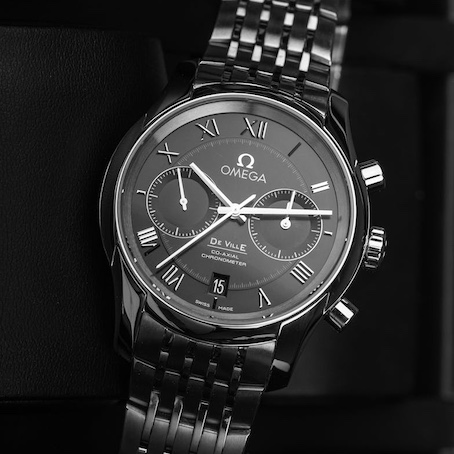
A dress watch is built around restraint: a thin case (typically under 10mm), a clean dial, applied indices rather than oversized numerals, and almost always a leather strap. Think Omega De Ville, Cartier Tank, Longines Master, Jaeger-LeCoultre Reverso.
It works because the thin case slides cleanly under a shirt cuff without bulking it, and the dial doesn’t compete with the outfit. The watch is there, but it’s recessive – the suit is doing the talking.
If you own one dress watch and one business suit, you have an outfit. It’s the safest pairing in menswear and there’s a reason every senior partner in every City firm has converged on some version of it.
2. The chronograph + structured tailoring
A chronograph is the watch most British men actually own, a TAG Heuer Carrera, an Omega Speedmaster, a Breitling Navitimer, a Tudor Black Bay Chrono. The case is heavier (typically 40–43mm), the dial busier, and steel is the default material.
This pairs beautifully with structured tailoring; a navy or grey wool suit with proper shoulder, a stronger lapel, the kind of suit you’d wear to a client meeting rather than a wedding. The watch’s weight and visual density match the suit’s. A chronograph on a leather strap pulls the formality up; on a steel bracelet, it pulls it slightly toward business-casual.
Where chronographs go wrong is on summer suits the visual mass fights with linen, cotton, lighter colour palettes. Save them for the structured half of the wardrobe.
3. The dive watch + the softer summer suit
This is the pairing that surprises most men. A steel sports watch (Omega Seamaster, Rolex Submariner, Tudor Black Bay) looks better with an unstructured linen or cotton suit than it does with a stiff worsted wool. The contrast of robust steel against relaxed fabric reads as deliberate. The same watch with a pinstriped charcoal suit reads as accidental.
For exactly the reasons sage green and earthier tones are having their moment in menswear and Fashion Capital has covered the styling logic of those palettes well, the sports watch sits inside the same tonal family. Steel against olive, sand, or stone reads as resort tailoring. Steel against pinstripe reads as a man who didn’t think about his accessories.
4. The vintage piece + the heritage textile
A vintage watch (a 1960s Omega Constellation, an older Longines, an Oris pointer-date, a vintage Cartier) has tonal qualities that modern watches struggle to replicate. Aged dials, mixed metals, patina that no factory can fake.
These pair almost uncannily well with heritage textiles: tweed, flannel, brushed cotton, knitted ties. The reason is partly tonal (gold cases against earth tones, off-white dials against cream shirts) and partly conceptual both the watch and the cloth signal an investment in things that age well.
If you’ve inherited a watch and you wear tailoring, this is the pairing to plan around.
The three pairings that don’t work and why
Oversized diver + slim-cut suit. A 44mm dive watch on a Neapolitan-cut shoulder is visually unbalanced. The cuff opening can’t accommodate the case properly, the lugs catch on the sleeve, and the visual weight of the watch fights the cut of the jacket. If your suit is slim, your watch needs to be too.
Two-tone gold-and-steel sports watch + cool-toned business suit. The classic 1980s combination that has never quite worked. Two-tone reads as warm; charcoal, navy, and cool greys read as cool. The clash is small but consistent — the eye picks it up without being able to name why. If you own a two-tone, pair it with browns, tans, and warmer greys instead.
Smartwatch + black tie. This is the pairing I’m asked about most often and the one I’m most direct about. A smartwatch on a tuxedo signals that you weren’t quite committed to the occasion. If you genuinely need notifications during a black-tie event, put your phone in your pocket. The watch on your wrist should be doing one job: marking time, elegantly. A simple, slim mechanical watch (even an inexpensive one) does that job better than the most sophisticated smartwatch.
The detail almost every man gets wrong: case size and cuff
The single most common pairing error I see, across all price points, is case size relative to wrist and cuff.
The shorthand most style writers offer (38–40mm for dress, 40–42mm for sport) is broadly right but misses the variable that actually matters. The case should sit between the two bones of the wrist (the radius and ulna) when your arm is at rest. If the case extends past either bone, it’s too big. If it gets lost between them, it’s too small.
Equally important: when you bend your wrist, the cuff opening of your shirt should pass over the watch without forcing it. If you have to push the cuff up to reveal the watch, the cuff is too tight or the case is too tall. A good tailor will adjust the cuff opening if you ask – most don’t ask.
In 2026, the watch industry has been quietly correcting for a decade of inflated case sizes. Most major houses have brought their flagship sports models back down: the Omega Seamaster 300M now exists in 41mm and 42mm rather than just 43.5mm, the Tudor Black Bay sits at 39mm and 41mm, even the Rolex Datejust holds at 36mm and 41mm. The era of the 45mm dress watch is, mercifully, over.
If you’re buying now, default to the smaller option in any model line. You’ll regret oversized cases in five years; you almost never regret restrained ones.
When the watch is the inheritance, not the purchase
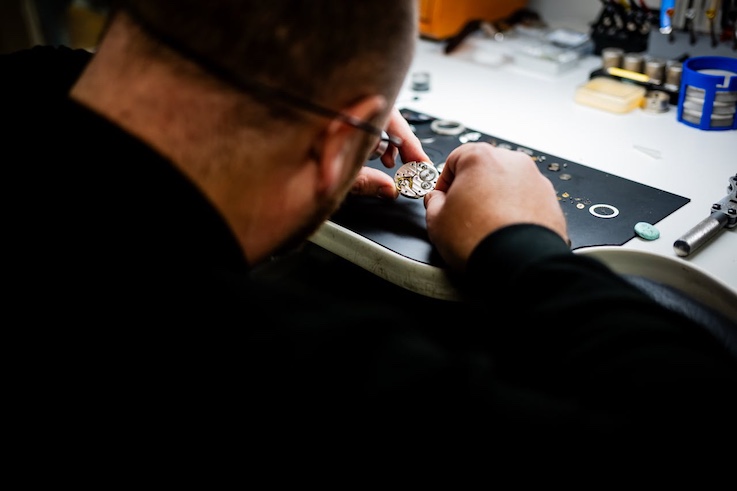
A growing share of the watches that come through our workshop are inherited rather than bought. A father’s Omega, a grandfather’s Longines, a wedding gift from forty years ago. The question I’m asked most often about these isn’t horological, it’s stylistic. Can I wear this?
Almost always, yes. Older watches are typically smaller, thinner, and more dial-restrained than their modern equivalents. They tend to pair more easily with tailoring, not less, because they were designed in an era when tailoring was the default.
The bigger question is condition. A vintage watch that hasn’t been serviced in twenty years isn’t safe to wear daily: moisture ingress, dried lubricants, and worn movement parts will eventually cause damage that’s expensive to reverse. Before incorporating an inherited piece into a regular rotation, have it assessed. Our team handles this through our vintage watch restoration service, but any reputable watchmaker can do a condition report. The cost of a condition report is almost always less than the cost of an avoidable repair.
Style buying versus keeping buying
A final point that I think is under-discussed in fashion writing about watches: there’s a meaningful difference between buying a watch you want to wear and buying a watch you want to keep.
If you’re buying for style (to finish an outfit, to fit a wardrobe, to mark a phase of life) almost any reputable Swiss or Japanese watch in the £500–£3,000 range will do the job. Movement quality at that price point is broadly excellent. The differences are aesthetic, not mechanical.
If you’re buying to keep (to wear daily for two decades, to hand on) the conversation changes. Service costs become material. A complicated chronograph might cost £400–£600 every five years to maintain. A simple three-hand automatic might cost £200–£300. Over twenty years and four services, that’s the difference between £1,600 and £800 in maintenance and the simple watch will be in better mechanical condition at the end of it.
This is the question I’d ask any man before he buys: Is this a watch you want to wear for the next decade, or a watch you want to wear for the next forty years? The honest answer should shape what you buy.
A short summary, for the man in a hurry
The pairing logic, distilled:
- A dress watch finishes a business suit. A chronograph finishes structured tailoring. A dive watch finishes a softer summer suit. A vintage piece finishes heritage textiles.
- Match the visual weight of the watch to the cut of the suit. Slim suit, slim watch. Structured suit, heavier watch.
- The case should sit between the wrist bones. The cuff should pass over the watch without forcing.
- Default to the smaller option in any model line. You will not regret it.
- If you’ve inherited a watch, get it assessed before you start wearing it. Then wear it.
The watch is a small detail. It just happens to be visible all day, every day, in close conversation. Worth ten minutes of thought.
Nick Francis is a Master Watchmaker at SwissMade, London’s official Service Centre for Omega, TAG Heuer, Cartier, Baume & Mercier, Longines, Tissot, Hamilton, Certina, Ebel and Fortis. Based in Hatton Garden since 1985, the workshop has serviced more than 70,000 timepieces for private clients and trade partners including Goldsmiths, H. Samuel and Watches of Switzerland.
Images via pexels.com


