


Eco Age’s Forever Label Campaign Calls For Clothing Brands To Disclose “Forever Chemicals”
05-06-2026


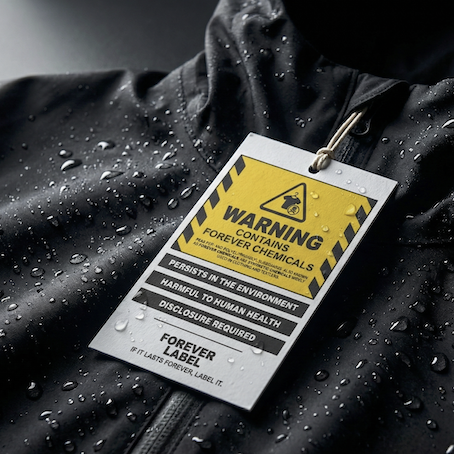
Eco Age’s Forever Label campaign calls for mandatory disclosure of PFAS on clothing and textile products sold in the EU, on physical hang tags and on digital product listings. The campaign made its European debut at the European Commission during Together in Action 2026.
With France’s ban now in force, Denmark’s starting in July, an EU-wide restriction tracking towards 2027 and UK MPs calling for a 2027 phase-out, shoppers still have no way of knowing whether their coat, blazer or sports kit contains PFAS.
Parents can now ask whether PFAS are in their drinking water. They still cannot ask the same question at the till about a school blazer, a raincoat or a pair of trainers.
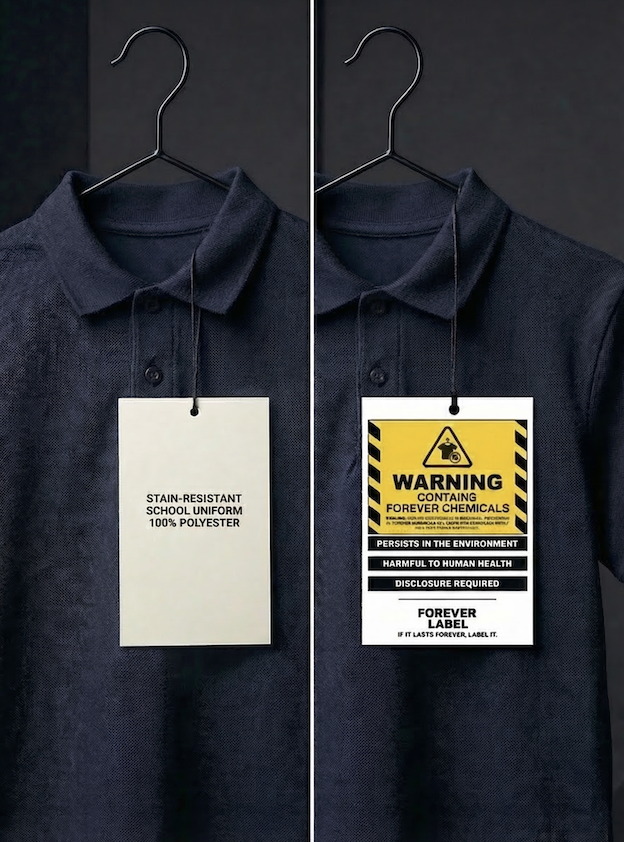
That is the gap sustainable fashion pioneers and communications agency Eco Age is calling on EU and UK regulators to close. As restrictions on per- and polyfluoroalkyl substances (“forever chemicals”) accelerate across Europe, the organisation today warned that bans alone will not protect consumers while the products still on shelves carry no disclosure of the chemicals used to make them.
The warning lands during one of the most decisive months yet for PFAS regulation in Europe. On 25 May, ECHA’s final consultation on the universal PFAS restriction proposal closes, with the Committee for Socio-Economic Analysis opinion expected by the end of 2026 and a European Commission legislative proposal tracking towards 2027. On 1st July, Denmark’s prohibition on the import and sale of clothing, footwear and waterproofing agents containing PFAS takes effect. In France, the national ban on PFAS in clothing textiles, cosmetics and ski waxes has been in force since 1st January 2026, with the scope extending to all textiles by 2030.
Yet currently, no EU or UK rule requires a clothing label to tell shoppers whether the garment contains PFAS. Existing labelling rules cover fibre composition. The European Environment Agency has warned that consumer textiles carry no obligation for a safety data sheet, weakening traceability once these chemicals enter a finished product.
Eco Age’s Forever Label campaign calls for mandatory PFAS disclosure on all clothing and textile products sold in the EU, on physical hang tags and digital listings alike, and for the UK to match that standard rather than drift into a slower, less legible regime.
The case for disclosure is hardening on three fronts:
Science. A peer-reviewed 2022 study published in Environmental Science & Technology detected PFAS in all 72 stain-resistant children’s textile products tested, with school uniforms containing significantly higher levels than several other children’s items. A 2024 University of Birmingham study was the first to confirm that PFAS can be absorbed through human skin, with the shorter-chain replacements now favoured by industry crossing the skin barrier more readily than their predecessors.
Cost. The European Commission’s January 2026 report, The cost of PFAS pollution for our society, estimates that if current pollution levels continue without regulatory action, PFAS will cost Europe approximately €440 billion by 2050. The Commission describes this as a “conservative estimate” because it covers only a handful of currently regulated substances out of the thousands of PFAS in use. Treating polluted water alone would cost more than €1 trillion. The study names newborns, children, people living near contaminated sites and workers at those sites as the populations most vulnerable.
Regulation. EU action is closing in on the consumer textile category specifically. Under REACH Annex XVII Entry 79, restrictions on PFHxA in consumer clothing apply from 10 October 2026, with consumer textiles other than clothing following on 10 October 2027 (European Commission, PE-18-2026-INIT). At UK level, the government’s first PFAS Plan (February 2026) commits to giving the public “clear, accessible information” on PFAS content and triggers a 2026 review of school uniform procurement guidance. On 23 April, the Environmental Audit Committee went further, recommending a phased restriction on PFAS in non-essential consumer goods from 2027, including school uniforms, standardised labelling on products still on the market, and warning that the UK risks falling behind the EU under UK REACH.
The Forever Label campaign made its European debut at the European Commission during Together in Action 2026 in March, where it secured engagement from Climate Commissioner Wopke Hoekstra and Director-General for Climate Action Kurt Vandenberghe.
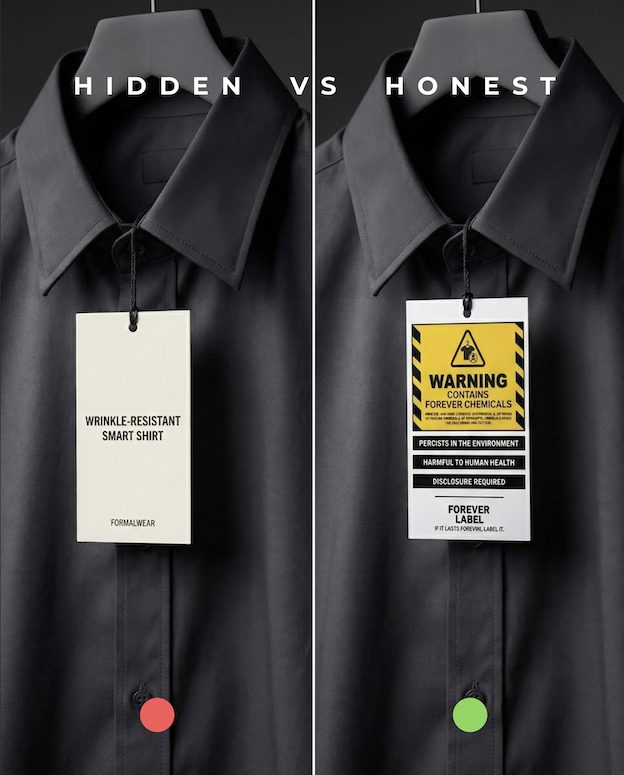
EU Climate Pact Ambassador and Eco Age Executive Director Marwa Zamaray said: “Families exposed to PFAS contamination are increasingly told to ask what is in their water. They cannot ask the same question at the point of sale about a school blazer, a raincoat or a pair of trainers. That is the transparency gap.
Restrictions matter. But while these products remain on shelves, people have a basic right to know whether forever chemicals have been used in their clothing. The information already exists inside supply chains. It just doesn’t reach consumers.”
The ask is simple: if it lasts forever, label it.
Visit: https://eco-age.com/theforeverlabel/ to find out more and sign the petition.
Images courtesy of Eco Age.


