


From Christmas Jumper to Christmas Pyjama: how ‘Fam Jams’ Are Becoming A Seasonal Favourite
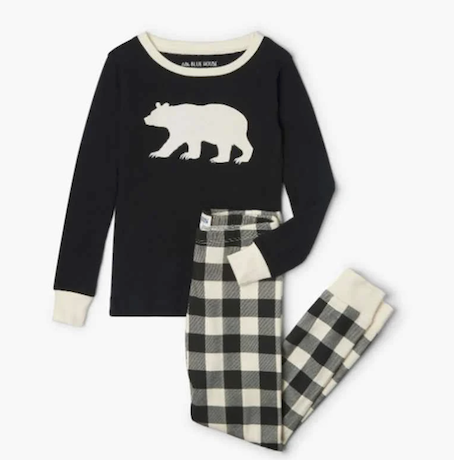
23-09-2026


The Christmas jumper has long been the defining garment of the festive season, but a new contender is increasingly making its presence felt in seasonal fashion: the matching Christmas pyjama. Once regarded largely as novelty sleepwear or a family photo opportunity, festive pyjamas have evolved into a significant seasonal product category, creating opportunities across print, colour, fabric, silhouette and coordinated product development.
The growth is becoming increasingly visible at retail level. Sainsbury’s reported a 22% year-on-year increase in Christmas pyjama sales in 2025, describing the performance as record-breaking, while its festive sleepwear was also promoted through TikTok Shop. Primark has similarly reported strong demand for its Fam Jams, with sales up 17% year-on-year, while research commissioned by the retailer found that 31% of British consumers planned to wear matching pyjamas at Christmas.
The trend is not entirely new. M&S introduced its first matching family pyjama sets in 2017 and says demand has continued to grow. By 2023, its Christmas family collection included six designs, with its Disco Santa motif reportedly selling more than 500,000 sets. Gap, meanwhile, reported a 40% increase in sales of Christmas pyjamas in the same period. Taken together, the figures suggest that matching festive sleepwear has moved beyond a short-lived social-media phenomenon and into the seasonal product architecture of major retailers.
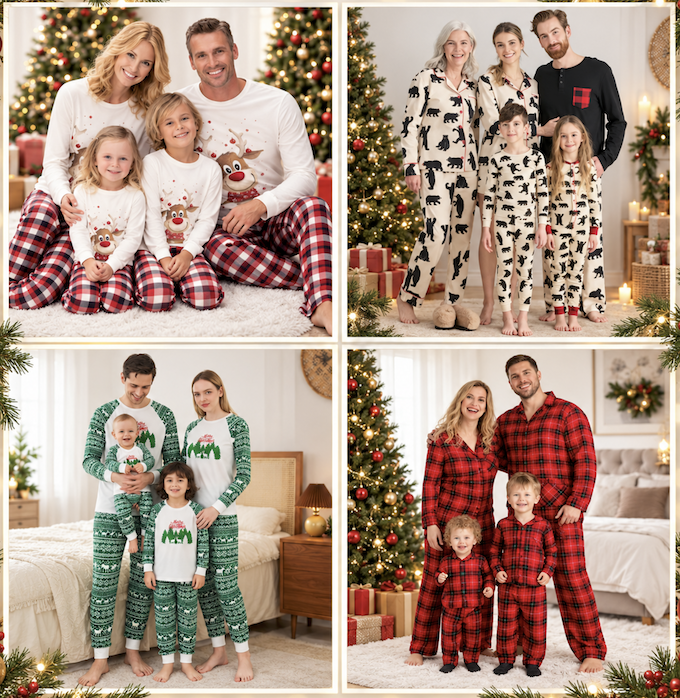
For the fashion and textile industry, the more interesting development is how sophisticated the category has become. Matching no longer necessarily means producing an identical garment for every member of the family. Instead, retailers are increasingly developing coordinated collections in which a common print, colour palette or design language can be translated across different ages, silhouettes and product types.
This shift opens up considerable scope for textile development. A single seasonal print can potentially be used across womenswear, menswear, childrenswear, babywear and even pet products, while different silhouettes allow the same design story to appeal to different consumers. Next’s current matching-family proposition, for example, extends across adults, children and pets, with themes ranging from tartan and Fair Isle to Santa, gingerbread and character-led designs.
Traditional Christmas colours remain central to the category. Red, forest green and white continue to provide the strongest visual shorthand for Christmas, particularly when combined with checks, tartans and Fair Isle-inspired patterns as seen at Pyjama Village. Yet the palette is broadening. Navy, burgundy, chocolate, oatmeal, cream, ecru and muted greens are increasingly being used to create a more contemporary interpretation of festive dressing.
This move towards quieter colourways is particularly significant because it gives Christmas sleepwear greater longevity. Rather than relying exclusively on overt novelty prints, more restrained checks, stripes and winter motifs can function as general cold-weather loungewear after the Christmas period. ASOS, for example, has promoted coordinated striped pyjamas as a seasonal option with appeal beyond Christmas itself.
Print remains one of the category’s major commercial drivers, however. Santa, reindeer, snowmen and gingerbread continue to dominate the novelty end of the market, alongside licensed characters such as Disney and The Grinch. For retailers this provides an opportunity for regular seasonal refreshes without having to reinvent the basic product architecture each year. A familiar pyjama silhouette can be given a new commercial life through a different print, colour combination or licensed story.
Fabric is also helping to move the category beyond basic novelty sleepwear. Cotton remains a core material, particularly for classic woven checks and printed sets, while brushed cotton and flannel provide the traditional winter proposition. Jersey offers softness and stretch, while fleece and velour cater to the increasingly important cosy and comfort-led end of the market. More elevated propositions are also appearing, including cotton-modal and TENCEL™ Modal constructions, signalling the influence of the broader premium loungewear market.
This diversification reflects a wider shift in consumer attitudes towards home dressing. Sleepwear and loungewear have increasingly become part of the visible wardrobe, particularly during the winter holiday period when much of the social activity takes place at home. Christmas pyjamas therefore sit at the intersection of sleepwear, loungewear, gifting and occasion dressing.
Silhouette is evolving accordingly. While the traditional long-sleeved shirt-and-trouser set remains the core format, current collections also include revere-collar sets, henley tops, nightshirts, leggings, T-shirts, sleepsuits, rompers and robes. The result is less a single product than a seasonal wardrobe built around a common design story.
Perhaps the most important development is that matching itself is changing. The original appeal was the novelty of everyone wearing exactly the same outfit. Increasingly, the emphasis is on coordination rather than uniformity. One family member might wear a traditional tartan shirt-and-trouser set, another a simpler jersey style, while children wear a more character-led version linked through colour, print or fabric.
That evolution gives designers and textile suppliers greater scope to develop cohesive collections rather than simply replicate one garment across multiple sizes. It also allows retailers to build larger baskets around a single seasonal story, extending from babywear and childrenswear through adult sleepwear and accessories.
It may be premature to suggest that the Christmas pyjama has overtaken the Christmas jumper, and public data does not currently isolate matching Christmas sleepwear as a discrete market. What is increasingly clear, however, is that the category is following a similar trajectory: a highly seasonal product has become a recognisable part of the festive fashion landscape.
The difference is that the Christmas pyjama is rooted in the home, where comfort, family dressing, gifting and social content converge. As retailers continue to expand their ranges and invest in coordinated collections, more sophisticated fabrics, colour palettes and silhouettes are giving festive sleepwear a level of product development that would have been difficult to imagine when matching family pyjamas first emerged.
Rather than simply being the sleepwear equivalent of the Christmas jumper, the festive pyjama may be developing into something more significant: a seasonal category in its own right.
Images courtesy of Pyjama Village


