


Creating Opportunity Through Inclusive Manufacturing: Neeraj Sharma, WeAreDaisyChain
21-09-2026


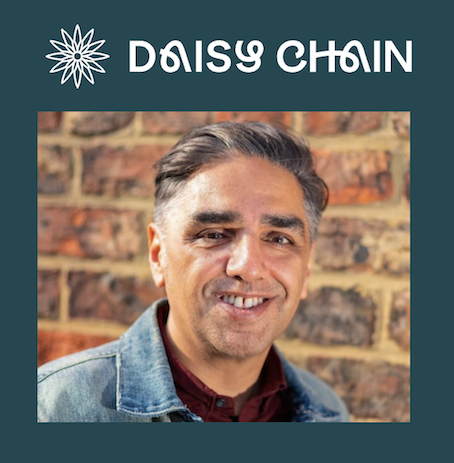
Fashion-Enter Ltd was delighted to welcome Neeraj Sharma (pictured above), founder of WeAreDaisyChain, to its recent industry meeting at the Palace of Westminster on 16th September, co-hosted with the UK Fashion & Textile Association (UKFT).
The meeting brought together representatives from across the UK garment and textile manufacturing sector, alongside organisations supporting the industry. It formed part of Fashion-Enter’s ongoing work to understand and address the challenges and opportunities facing UK-based manufacturers, particularly around access to public procurement, skills development and creating a stronger, more resilient domestic manufacturing base.
Neeraj’s contribution brought a powerful additional perspective to these discussions: what happens when inclusion, sustainability, skills and commercial manufacturing are brought together?
From textile waste to opportunity
Neeraj’s work with WeAreDaisyChain began with a very practical challenge. Daisy Chain receives around 2,000 bags of donated textiles every week, yet only approximately one-third of these donations are suitable for conventional resale.
Rather than viewing the remaining material simply as waste, Neeraj saw an opportunity to create something new — Neuthread, a neurodivergent-led circular fashion enterprise designed to transform textile waste into high-value British fashion.
What began as a concept has progressed to London Fashion Week and funded UK production, demonstrating how circularity can move beyond discussion and into genuine manufacturing.
But Neuthread represents something much bigger than a sustainable fashion initiative. It provides a model for exploring how neurodivergent people can participate meaningfully in the manufacturing economy, with real skills, real production and real commercial outcomes.
Learning from international manufacturing models
Neeraj’s Churchill Fellowship gave him the opportunity to explore this question internationally. His research examined how a stronger blueprint for neurodivergent employment in sustainable manufacturing could be developed, including visits to organisations across the United States. One of the most important lessons was that successful inclusive employment models were not simply short-term employment projects.
Neeraj encountered independent organisations operating genuine manufacturing businesses, employing disabled and neurodivergent adults while working to real production targets, quality standards and customer requirements. The manufacturing was diverse, encompassing activities such as cutting, sewing, printing, embroidery, garment production, military hats, uniforms and PPE, alongside warehousing, fulfilment and logistics. Crucially, these were functioning businesses.
For inclusive employment to be sustainable, people need more than an opportunity to participate. They need access to skills, machinery, progression, responsibility and meaningful commercial work.
Discovering skills through opportunity
One of the most striking examples Neeraj shared was that of Kendrick, whom he met during his Fellowship. Kendrick had never used a sewing machine before joining the organisation. With exposure, training and technical development, he progressed to operating highly specialist cutting equipment, equipment for which the company had previously struggled to recruit externally.The lesson is significant.
Capability is not always something that can be identified before someone is given the opportunity to develop it.
By creating pathways into manufacturing and providing the right support, businesses can discover skills and potential that conventional recruitment processes may overlook.
For an industry facing ongoing skills challenges, this has relevance far beyond neurodivergent employment. It asks manufacturers to consider whether some of the skills they are struggling to recruit already exist within people who simply have not previously had the opportunity, support or pathway into the sector.
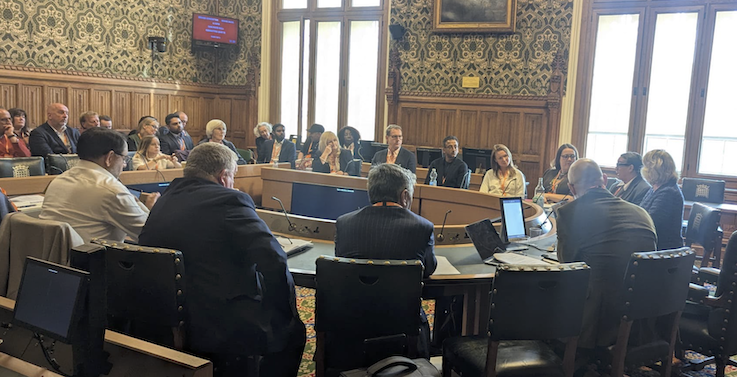
(Meeting at the Palace of Westminster on 16th September)
Procurement can create genuine demand
Another central theme of Neeraj’s presentation was public procurement. His experience demonstrated the importance of moving beyond a model where government or other organisations simply fund employment support. Instead, public bodies can create genuine commercial demand by purchasing goods and services from viable manufacturers that employ disabled and neurodivergent people. That distinction can be transformational.
When a business has real customers, real orders and real production requirements, employment becomes embedded within the commercial operation rather than sitting alongside it as a separate initiative.
For the UK fashion and textile sector, this is particularly relevant. Public procurement has the potential to support domestic manufacturing while simultaneously creating opportunities for people who have historically faced barriers to entering or progressing within the workplace.
Connecting skills, support, manufacturing and commissioning
The recommendations emerging from Neeraj’s Churchill Fellowship bring these themes together.
His proposed approach considers the relationship between:
- Skills development
- Supported employment
- Manufacturing
- Neurodivergent inclusion
- Disability-inclusive workplaces
- Circular production
- Public procurement
- Genuine commercial demand
His wider vision, including the proposed NeuSemble model, explores how these components could connect to create a more sustainable approach to neurodivergent and disability-inclusive manufacturing.
As Neeraj explained during the meeting, the opportunity is to connect skills, support, manufacturing and commissioning in a way that can create thriving people, thriving businesses and stronger British manufacturing.
A natural alignment with Fashion-Enter Ltd
For Fashion-Enter Ltd, these principles strongly align with the organisation’s own ethos. Fashion-Enter has long focused on the importance of developing manufacturing skills, supporting learners and creating pathways into the UK fashion and textile industry. The organisation’s work increasingly recognises that the future of manufacturing depends not only on technology, investment and production capacity, but on people and the different ways in which people learn, develop skills and contribute to industry.
Jenny Holloway, CEO of Fashion-Enter Ltd, said: “It was an opportunity that WeAreDaisyChain created when they contacted Fashion-Enter independently. The sustainability aspects of WeAreDaisyChain align perfectly with Fashion-Enter, and meeting Neeraj in person proved without doubt the importance of neurodivergent provision within education.
“It is an opportune time, as the All-Party Parliamentary Group work has asked us to look deeper into differentiated learning plans for all levels of learners. The resulting work that Neeraj undertook as a Churchill Fellow proved without doubt that every learner has the right skills to be part of the manufacturing process.
“Without doubt, the examples from the USA and Europe show that the old system of employment had many merits in terms of the support required for neurodivergent learners. The problem was that it wasn’t commercially facing — their factories needed to be.”
A different way of thinking about the workforce
The fashion and textile manufacturing sector is facing a complex combination of challenges: skills shortages, changing consumer expectations, sustainability requirements, pressure on costs and the need to strengthen domestic production. Neeraj’s work suggests that part of the answer may lie in changing how we think about the workforce itself. It also reinforces the importance of designing education and skills programmes around the realities of modern manufacturing.
Neeraj’s Churchill Fellowship report is now in its final stages, referencing and publication preparation, and will provide a more detailed account of his research, recommendations and proposed NeuSemble model.
Fashion-Enter looks forward to continuing the conversation and exploring opportunities for collaboration with WeAreDaisyChain.
The Westminster meeting demonstrated the value of bringing different parts of the fashion and textile ecosystem together — manufacturers, educators, sustainability organisations, policymakers and organisations working to create more inclusive employment. There is a significant opportunity to build a UK manufacturing sector that is not only more sustainable and resilient, but more inclusive.
To find out more about WeAreDaisyChain tap here.


