


One Day at London Fashion Week: From High Street to Made-to-Order and the Future of Fashion
22-09-2026


If I had to describe London Fashion Week in one word, it would be inclusive. Not necessarily because everyone was dressed in the same way, quite the opposite, but because this season seemed determined to squeeze as many different versions of fashion into one five-day schedule as humanly possible.
From high street to high fashion, established names to emerging designers, heritage brands to repurposed deadstock, and from the grand surroundings of the Design Museum to a fashion show tucked into the back of a record shop, London Fashion Week had plenty to keep the fashionably curious on their toes.
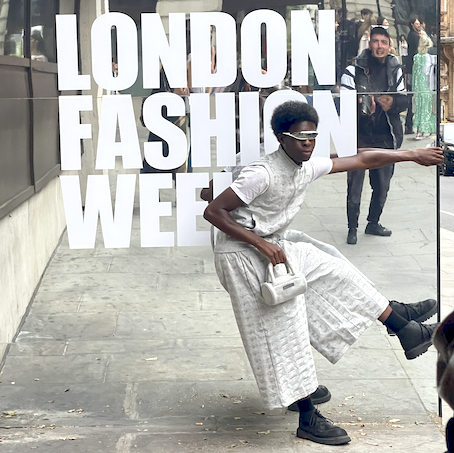
And, of course, there was the usual LFW side show: watching what the fashion crowd themselves were wearing, reworking and styling up. There is nothing quite like standing outside a show while everyone simultaneously photographs everyone else.
M&S Join The Schedule Sparking ‘High Street Brand Inclusion’ Debate
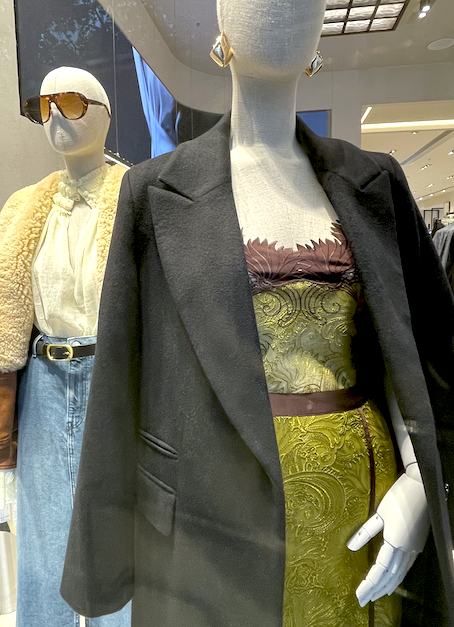
M&S From catwalk to online and in-store
One of the season’s most talked-about additions was Marks & Spencer making its first appearance on the official London Fashion Week catwalk, celebrating 100 years of M&S fashion. The show took place at the Design Museum and featured 59 looks drawn from the brand’s archives, with the collection available to buy immediately, eschewing the usual 6-month forward format.
M&S has clearly given its fashion offer a considerable 2026 injection. There was tailoring, knitwear, sequins, lace, tuxedos, twinsets and plenty of those dependable classic pieces refreshed. And therein lies the interesting bit. There has been plenty of discussion about the presence of high-street giants at London Fashion Week, particularly around questions of scale, production and sustainability. H&M also had a major presence this season, collaborating with Nick Knight and SHOWstudio on an experimental fashion presentation.
It is an interesting tension. On one side you have small designers making highly considered, often limited, reworked, or made-to-order pieces. On the other, you have brands whose enormous customer bases depend on fashion being accessible and affordable. Personally, I found myself torn. My heart lies with the independents and the sustainable reworkers, however, I cannot ignore that the industry is predominantly run by the high street giants and mass production.
Of course we want closer-to-home production, quality materials and greater transparency. But we also have to acknowledge that the high street is where the majority of people actually buy their clothes. The M&S collection wasn’t exactly going to rewrite the fashion rulebook, but it was chic, wearable and commercially savvy. And with half of the collection priced below £50, accessibility was clearly part of the proposition.
I couldn’t help thinking, however, that if this had been four decades ago, more of it might have been made in Britain. Now, that would have made for an interesting anniversary story.
Then came the protests…
If M&S brought the high street into the LFW conversation, PETA brought the animal rights conversation to H&M. PETA protesters took to H&M’s show to object to the brand’s use of wool, following a similar protest at COS’s show during New York Fashion Week, and the much publicised CFDA (Council of Fashion Designers of America) CEO Steven Kolb, physically manhandling the protester. PETA’s position is that animal-derived fibres such as wool should be rejected, while others within the industry argue that responsibly produced wool can have a role to play as a more sustainable fibre option.
Whatever your opinion, the protests demonstrate just how much scrutiny the fashion industry is under and that scrutiny is a good thing for instigating change, hopefully for the better. Sustainability is no longer a nice little paragraph at the bottom of a press release. It is becoming analysed and part of the main event.
Ray Chu: fans, flowers, tailoring and a sea of phones
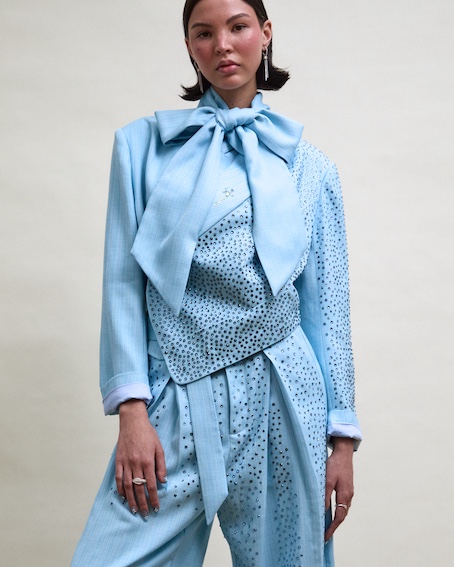
Ray Chu SS27
From the very commercial to the decidedly more independent, Ray Chu‘s Fans Only Club collection for SS27 offered a completely different take on contemporary fashion. Inspired by Taiwan’s Sambucus flower, with its delicate white blossoms gathered in cloud-like clusters, the collection explored strength, connection, community and identity through a gender-fluid wardrobe of refined tailoring, reworked cotton shirting, translucent layers and body-conscious silhouettes.
There was plenty to like: elevated everyday pieces with quirky twists, clever detailing and the sort of wearability that makes you think, I could actually have that in my wardrobe. The only problem was trying to see it. Arriving with the first wave of attendees, I quickly found myself behind what appeared to be the entire population of London Fashion Week, all holding their phones at exactly the height required to block my view. After several attempts at strategic head positioning, I eventually accepted defeat and found myself distracted by the rather unexpected Hello Nancy table of tennis-inspired pleasure devices. You can’t say London Fashion Week isn’t diverse.
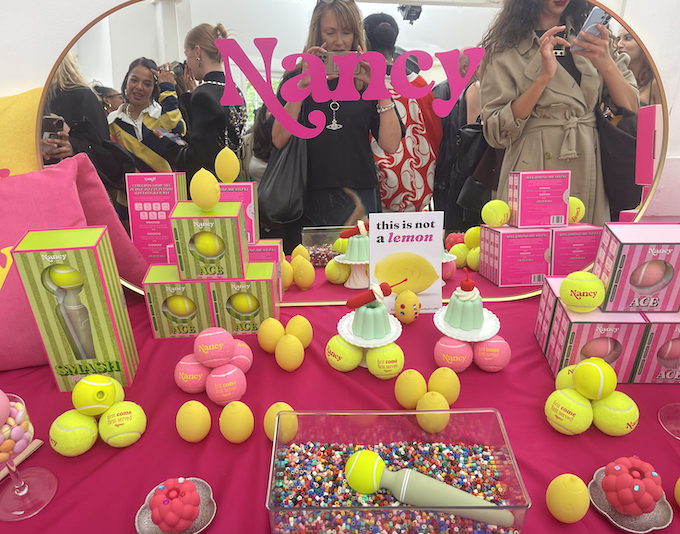
Hello Nancy table at Ray Chu
Poet-Lab: fashion with something to say
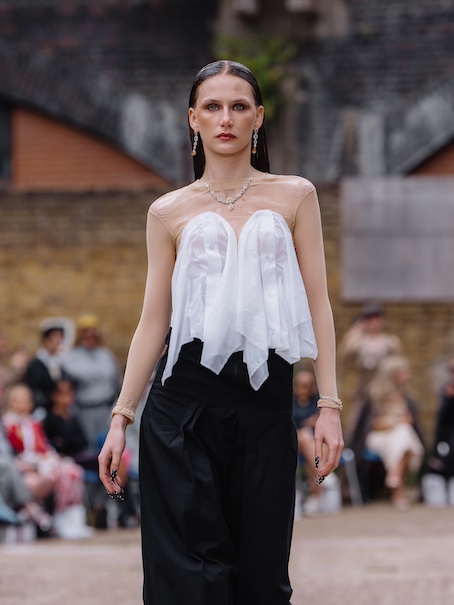
Poet-Lab SS27
For me, however, one of the most compelling moments came from Poet-Lab. Presented outdoors in the urban landscape of Bethnal Green, with the tube providing an almost perfect London soundtrack and backdrop, Poet-Lab’s REMEMBER collection demonstrated exactly why London needs its independent voices.
Poet-Lab’s work is rooted in repurposed deadstock fabrics, and REMEMBER explored memory as part of identity and as a quiet form of resistance in a world increasingly shaped by conformity. The collection moved between structured and fluid forms, with draping creating movement and drama against a largely monochrome palette. But what really struck me was the thought behind the presentation. Inclusion wasn’t just a word on the invitation. From the models to the way the audience was arranged, there was a genuine consideration of who gets to participate and how fashion is experienced. Fashion can talk endlessly about inclusivity, but occasionally you encounter a designer who actually builds it into the DNA of the show. Poet-Lab did just that.
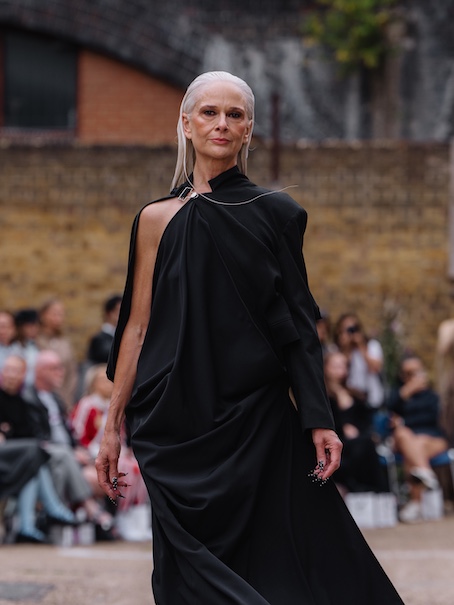
Poet-Lab SS27
Fashion and edustry
Then came one of my favourite discoveries of the week: the London College of Contemporary Arts show, held in the depths of Phonica Record Store in Soho. Forget the pristine white cube. Give me a record shop, a slightly unexpected entrance and a collection of emerging designers brimming full of ideas and enthusiasiam.
LCCA’s Dean of Creative Industries, Lucy London, introduced the next generation of talent, linking education directly with industry. I rather like the word “edustry” for this — education and industry working together rather than waiting for graduates to finish studying before anyone bothers to introduce them to the working fashion world. And the fashion world clearly agreed. With Dame Zandra Rhodes in attendance to see the students’ work, adding a little extra flash of colour to what was already an exciting showcase.
The collections demonstrated just how much fashion education has evolved. There were ideas about identity, sustainability, history, gender, emotion, materials and the body. In other words: plenty to think about, as well as plenty to wear.
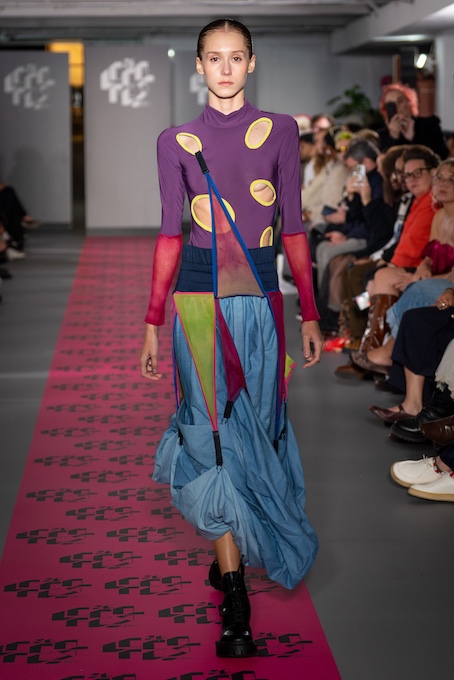
Anita Cannito
Bones, rebellion, heartbreak and cephalopods
Packed full of innovation and ideas and although deserved, it would take too long to feature every designer, highlights included: Anita Cannito’s Bones of Strength – a deeply personal, drawing on her childhood experience of living with leukaemia and the support of her mother during illness and recovery.
The collection translated ideas of strength, protection, fragility and resilience through silhouette, construction and material. It was a reminder that fashion can carry memories that are considerably heavier than the garments themselves.
Deanne Forbes’ Rebellion took on identity, gender norms and disposable culture through unisex silhouettes and hybrid streetwear tailoring. Garments became a form of armour and self-expression — clothes designed to move across bodies rather than dictate who should wear them.
Then came Gabrielle Nitu’s Romantic Homicide, which, thankfully, wasn’t quite as alarming as the title suggested. Exploring the emotional stages of a relationship — denial, sadness, anger, revenge and eventually healing — the collection used deep reds, blacks and whites, with flowers reflecting Nitu’s experience as a florist and becoming symbols of emotion and transformation.
Lizzie Molloy’s Externally Internal took inspiration from one of fashion’s more unexpected muses: cephalopods. Octopus, squid, cuttlefish and nautilus became a way of exploring intelligence, mimicry and non-verbal communication. Textiles, colour and print considered how emotion might be communicated through the body, while recycled plastic filament brought the issue of ocean pollution into the material story. No doubt the oceans cephalopods have something to teach fashion, not forgetting, the environment.
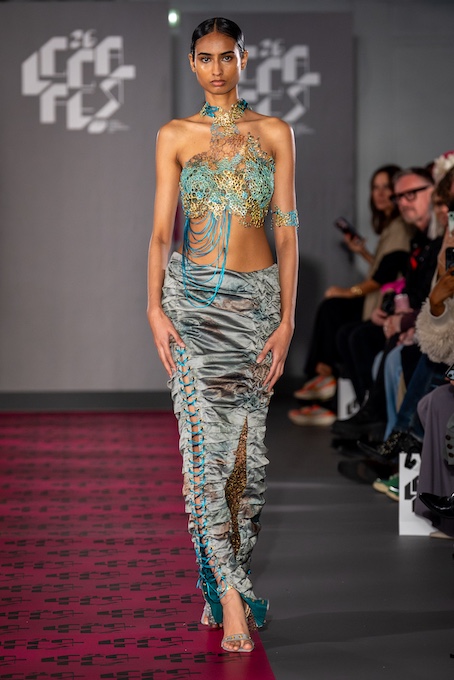
Lizzie Molloy
A little bit of Scotland, a little bit of fantasy
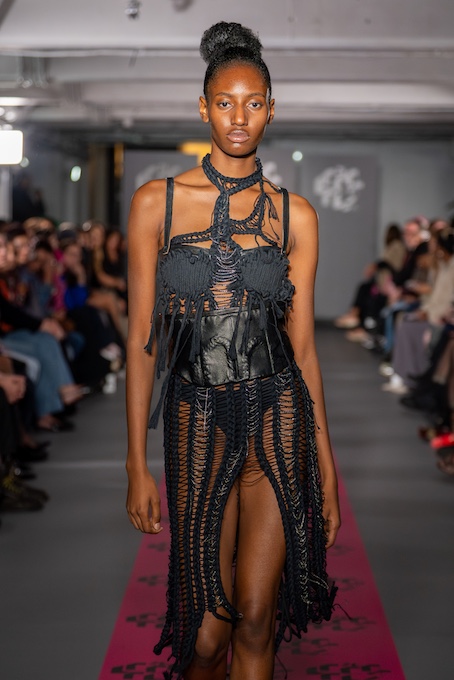
Tara Kari
Sacha John Coull’s Killiecrankie looked back to the 1689 Battle of Killiecrankie and the designer’s birthplace in Scotland, exploring heritage, resistance, identity and belonging. It was a good example of how young designers can take history and make it personal rather than simply reproducing it.
Tara Kari, meanwhile, occupied the territory between fantasy and frustration. Away with the Fairies celebrated dreamers and wanderers through fluid silhouettes and unexpected materials, while Outraged took a darker turn, using fractured silhouettes, contrasting textures and rigid and fluid materials to express suppressed emotion.
Together, these collections demonstrated something that is easy to forget when we spend so much time discussing the commercial side of fashion: young designers have ideas. Lots of them. And thankfully, they aren’t waiting for permission to use them.
All LCCA show images by Stefan Ciulu
Birmingham, LCF and the wider talent pool
LCCA wasn’t alone in putting education firmly on the LFW agenda. Other institutions, including Birmingham City University and London College of Fashion, were also showcasing the next generation of designers. This feels increasingly important if the industry is to work as a whole.
The future of fashion isn’t going to be created solely in the studios of established luxury houses. It is being developed in university workrooms, college studios, shared spaces, kitchen tables and wherever else emerging designers can find somewhere large enough to use as a micro studio.
London Fashion Week’s official programme itself emphasised the breadth of the UK’s fashion community, bringing together established houses, emerging designers, cultural programming and, for better or worse, retail partners and that mixture is precisely what makes London interesting.
The real catwalk on the street
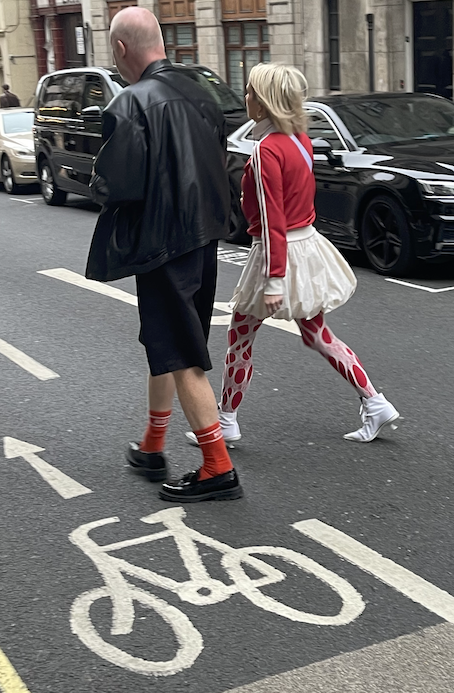
Of course, no LFW experience would be complete without observing the audience. There were immaculate fashion editors, designers wearing what looked like unfinished masterpieces, people who had clearly spent three hours deciding to look as though they had spent three minutes getting dressed, and the obligatory individuals whose outfits were so bold you pondered their bravery in walking the streets. One reoccurring theme was to include a shock of bright colour, whether that choice came about for a good shot on instagram or a collective feeling of wanting to inject some happiness and fun into our troubled world, who knows.
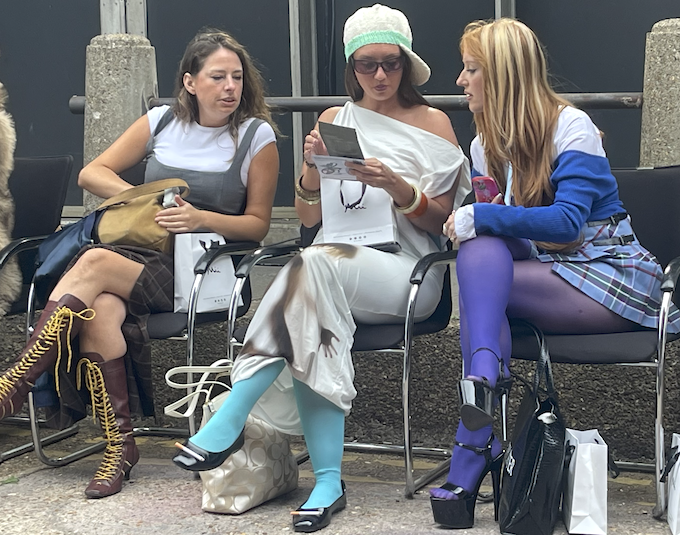
Until next time, LFW!


