


Before You Contact a Bag Manufacturer: A Practical Brief for First-Time Founders
October 19, 2026 - October 19, 2026


You don’t need every production answer before the first conversation — just enough clarity for a manufacturer to spot the assumptions, the risks and the right next step.
By Andy Zuo, Founder, ISUNDEI
Not long ago, a client sent us a design with an internal sunglasses pocket. We checked the size with him more than once, and his answer was always the same: “It’s just for ordinary sunglasses.” So we built it around a standard pair.
The sample came out well — except that pocket. His customers wear oversized sunglasses, and they wouldn’t quite fit. Remaking the sample cost us close to ten days.
I don’t blame him. We asked; he answered honestly. But “ordinary sunglasses” meant one thing to him and another to us. One pair of the actual glasses — or just their measurements — would have saved the whole detour.
Most first enquiries carry this kind of hidden assumption. A founder sends a few reference images and asks, “Can you make something like this?” It’s not a bad place to begin — it’s just not enough for a proper development assessment. Without context, the factory has to guess what the bag is for, what it carries, which details actually matter, what quantity is realistic, and whether the reference is inspiration or specification.
You don’t need a perfect tech pack before speaking to a manufacturer. A concise working brief is usually enough. The aim isn’t to settle every detail — it’s to make the important decisions visible and give both sides a far more productive first conversation.
Start with the job the product must do
Begin with the product’s use, not its appearance.
“A black leather backpack” describes a look. “A work backpack for a 13-inch laptop, charger, notebook and a daily commute” gives a development team something they can actually evaluate.
Intended use drives the opening, pocket layout, reinforcement, strap construction, lining, hardware and finished weight. A small evening bag and a commuter bag might share a visual language, but they shouldn’t be engineered around the same assumptions.
Your brief should cover:
- who will use the product
- what they’re likely to carry
- how, and how often, it will be used
- whether it should hold its shape or feel soft and relaxed
- where it will be sold, and the quality level that customer expects
If you’re unsure about a construction detail, describe the user problem instead. “The customer needs to reach a travel card without opening the main compartment” tells us far more than a pocket solution chosen before the structure has been reviewed.
Give dimensions a real-world reference
Reference photos distort proportion. A compact-looking tote in a campaign image may be much larger than it appears; a backpack shot on a tall model may look smaller than it is.
Give approximate length, height and width, plus handle drop or strap range where they affect use. If the size is still open, list the objects the product must hold — a laptop model, a water-bottle size, wallet dimensions. Any of those beats “medium size”.
For fitted compartments, spell out the required fit rather than leaving us to infer it. This is exactly what went wrong with the sunglasses pocket — the word “ordinary” did the job a measurement should have done. The same applies to openings: an internal pocket can be big enough on paper and still awkward to use if the zip position is too restricted.
Early dimensions don’t have to be final. They just need to be specific enough to reveal conflicts between capacity, proportion, weight and structure.
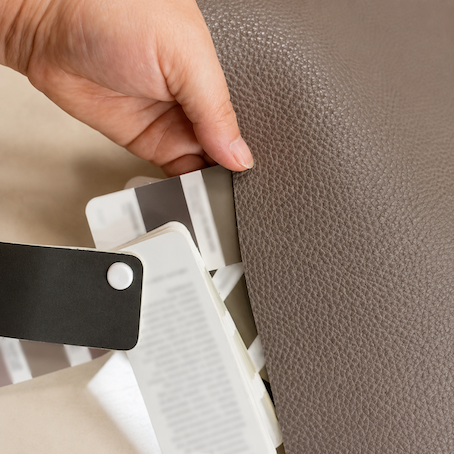
Comparing leather colour and surface finish during the product development process.
Use references to communicate, not to copy
A mood board, market sample or reference image can explain shape, material feel, hardware scale and level of structure. The trouble is that a factory can’t tell which parts of a reference matter unless you mark them.
For every important reference, add two short notes:
- what you want to keep
- what you want to change
You might keep the proportion but change the opening, soften the body, lengthen the handle, swap a metal lock or add an internal pocket. That turns a picture into a development instruction — and makes clear the goal is an original product, not a copy.
If you’re using several references, label the purpose of each. One shows silhouette, another the handle, another the surface finish. Otherwise the development team may combine details that were never meant to work together.
Describe a material direction and its priorities
You don’t need to arrive with an exact material code, but you should be able to describe the direction and the reason behind it.
Tell us whether the main material should be genuine leather, PU, coated fabric, canvas, nylon or a combination; whether the handfeel should be soft or firm; whether the surface should be smooth, pebbled, matte or glossy; and whether low weight, shape retention, weather resistance or natural character matters most.
Material is never just a surface decision. A swatch that looks right can behave differently once it’s cut, folded, stitched, edge-finished and combined with lining or reinforcement. A very soft material may not hold the intended shape. A heavy one changes carrying comfort. A finish may react badly around tight corners or embossed branding.
With genuine leather, natural grain and colour variation need discussing too. It isn’t a uniform sheet, so brand and factory need a shared expectation for appearance and consistency before production.
Tell the manufacturer which qualities are non-negotiable and which are preferences. That leaves room to propose a workable alternative without losing the product’s purpose.
State the quantity, colour plan and timing honestly
“What’s your MOQ?” is rarely a complete planning question.
The workable quantity depends on the main material, colour split, lining, zip, hardware, custom moulds, branding method and packaging. Take lining as an example: a custom-dyed lining colour usually carries a supplier minimum of around 500 yards. That’s why, for smaller orders — we accept an MOQ of 50 pieces — we’ll offer clients our existing lining colour cards to choose from rather than custom-dyeing. The bag still gets made; one component simply follows a different route at that quantity.
Share your best current estimate for:
- total first-order quantity
- number of colours, and quantity per colour
- whether this is a market test or a full launch
- desired sample date and launch window
- destination country
Quantity changes the recommendations a factory makes on materials and components, so an honest range is far more helpful than a hopeful one.
Inflating your quantity to get a better price almost always backfires.
Timing should include sampling and at least one revision round, not just production. If a trade show, retail appointment or crowdfunding date can’t move, say so at the start. The development route may need to change — or the honest answer may be that the date isn’t realistic.
Send the logo, but keep the method open
Provide a vector logo file if you have one, an approximate position, and the visual effect you’re after. It also helps to say whether the branding should be discreet, highly visible, tonal or metallic.
Don’t finalise the logo method before the material and construction are understood. Debossing, foil, screen printing, woven labels, metal badges and engraved hardware each affect tooling, minimums, durability and placement differently. A method that works on a flat swatch can distort over foam, backing or a seam.
You own the brand expression. The manufacturing review tests whether the proposed method and position suit the final material stack and the product’s use.
Explain the quality context, packaging and destination
“Premium” and “high quality” mean different things to different people, so make them practical.
Describe the target customer, the retail channel and the details that will shape their judgement — stitch appearance, edge finishing, lining, zip movement, hardware weight, surface consistency, logo alignment, or how well the bag keeps its shape in use.
Packaging belongs in the early brief too. A product sold through e-commerce needs different protection and labelling from one delivered to a boutique. Mention any known requirements: dust bag, box, hangtag, care card, barcode, retail label, carton mark.
The destination country lets the factory discuss packing and delivery on the right basis. It doesn’t replace professional advice on product compliance, but it stops logistics being treated as an afterthought.
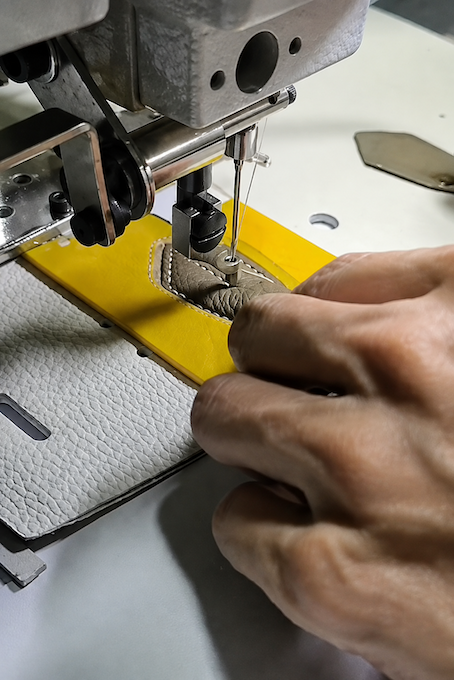
A sample being stitched during the development process, where construction decisions are tested in practice.
Decide what must be fixed and what should stay open
One of the most valuable parts of a founder’s brief is a short priority list.
Mark the details that define the product and can’t change — perhaps the capacity, a signature silhouette, a particular carrying method or a brand-specific closure experience. Then mark what can stay open until the first manufacturing review.
|
Fix in your brief |
Leave open for manufacturing review |
|
Intended use, capacity and real contents |
Reinforcement and internal construction |
|
Signature silhouette and carrying method |
Material thickness, backing and support layers |
|
Must-have features and compartments |
Compatible zip and hardware specification |
|
Brand expression and preferred logo position |
Final branding technique, once the material is confirmed |
|
Quantity, colour plan and launch constraints |
Practical simplifications that improve repeatability |
This is the real value of an early design-for-manufacturing review. Nobody’s asking the factory to redesign your product — it’s a check that the chosen structure, materials and components can work together and be repeated in production.
Keeping some decisions open doesn’t mean the idea is unfinished. It stops you locking in a detail before you understand its effect on cost, durability, minimums or consistency.
A one-page brief is enough to start
For a first conversation, pull the following into one document or a well-organised email:
|
Brief item |
What to provide |
Why it matters |
|
Product purpose |
User, use case, real contents |
Drives capacity, structure and weight |
|
Size |
L × H × W, handle drop, fitted objects |
Exposes proportion vs. capacity conflicts |
|
References |
Annotated images: keep vs. change |
Prevents copying and wrong assumptions |
|
Material direction |
Family, handfeel, finish, non-negotiables |
Links the look to structure and sourcing |
|
Components |
Opening, handles, straps, closures, hardware |
Shows where function and build interact |
|
Branding |
Vector logo, position, desired effect |
Lets the method follow the material |
|
Order plan |
Quantity, colour split, key dates |
Grounds sourcing and timing honestly |
|
Quality & delivery |
Retail context, packaging, destination |
Aligns expectations before sampling |
Name each file clearly. If you send revised information later, add a date or version number. A simple version trail stops an old measurement, colour or logo position sneaking back into the sample discussion — it happens more often than you’d think.
Ask for an assessment, not just a price
A quotation matters, but the first exchange should also show you how the manufacturer thinks about your product.
Questions worth asking:
- What assumptions have you made from my brief?
- Which missing details prevent an accurate sample or quotation?
- Is the material direction realistic for this quantity and structure?
- Which part of the design creates the greatest production risk?
- Will any sample component be temporary, or different in production?
- What must be approved in writing before bulk production?
These questions surface uncertainty early, while changing direction is still cheap.
A good first brief doesn’t need to answer everything. It needs to replace hidden assumptions with visible decisions — like a pair of sunglasses measured instead of described. That’s what leads to a quotation you can trust, a first sample that’s actually relevant, and a clearer picture of what it will take to manufacture the product well.
Andy Zuo is the founder of ISUNDEI, a B2B development and manufacturing partner for custom leather goods and backpacks. He works with founders and growing brands on product briefs, manufacturing reviews, sampling, production and quality control.
Images courtesy of ISUNDEI


