


Before Approving A Leather-Goods Sample: Make The Decision Traceable
October 22, 2026 - October 22, 2026


“Approved, subject to widening the opening” leaves a leather folio between two decisions. The designer has accepted its appearance. Someone still needs to define the alteration, review the result and authorise the version that production will follow.
For a fashion brand developing an accessory, the useful question at sample approval is precise: which physical piece and written specification are we asking the atelier to reproduce? A short approval record can answer it, provided every requested change has an owner and a clear route to closure.
The following buyer framework follows one fictional correction from sample A to revision B. It shows how to capture that decision without turning a sample review into an exhaustive catalogue of defects.
Give approval a specific object
Start by identifying the piece on the table: product reference, sample revision, material and colour references, and the dated specification being reviewed. Put the same identification on its photographs. Keep superseded samples labelled so that an attractive earlier version cannot quietly become the reference again.
Then name the people making the decisions. A designer might approve the silhouette and branding; a product developer might review dimensions and access. Assign one person authority to issue the brand’s final production release. The atelier should know whose instruction settles a disagreement.
Write the intended use beside the reference. “Fits a notebook” leaves too much unanswered. Name the actual notebook, including any cover, and specify whether the folio must close with a pen in its holder. Use those same contents when reviewing the revision.
Follow one correction from A to B
Illustrative example: fictional leather-folio development, offered as a buyer framework. A brand is reviewing folio F01, sample A, against specification 01. Its selected notebook, labelled N1, catches at the opening during insertion. The reviewer has to pull the opening apart to pass the notebook through. The brand requests easier access while retaining the approved outer silhouette.
Record that observation directly. “Poor fit” gives the maker less to work with than the object used, where it catches and the movement required to insert it. A photograph can mark the contact point; a short video can show the action.
The five fields below keep the discussion attached to a decision.
| Field | Illustrative entry |
| Item and reference | F01, sample A, specification 01; notebook N1 with its selected cover; reference photographs labelled A. |
| Intended requirement | With the folio laid flat and fully open, insert N1 spine-first without manually spreading the opening. With N1 and the selected pen inside, the closure must engage without compressing the notebook. Agree the finished opening dimension and permitted variation with the maker before revision. |
| Observed issue | N1 catches at the opening in sample A; the reviewer pulls the opening apart to complete insertion. Record the contact point on photograph A-03. |
| Action and owner | Atelier proposes an opening revision and updates the drawing. Brand product developer agrees the access requirement and measurement convention; designer confirms the retained silhouette. Atelier supplies sample B against specification 02. |
| Evidence that closes the decision | Review B using the same contents and insertion method. Record the opening measurement, photograph the agreed measuring points, and capture insertion and closure. Product developer signs acceptance against specification 02; designer confirms the appearance. |
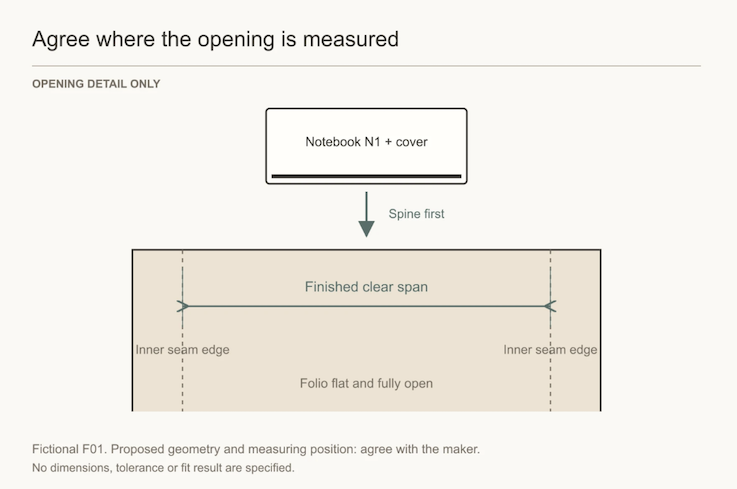
Before making B, settle how the opening will be measured. For this example, the proposed view shows the finished clear span between the marked inner seam edges, with the folio flat and fully open. Ask the maker to confirm that position and record the agreed dimension and allowable variation. The values belong to the project: copying an unrelated tolerance would leave the acceptance decision unsupported.
Illustrative opening detail for fictional folio F01; agree the measuring position and permitted variation with the maker.
Continue the fictional record through the return visit. In B, N1 passes through using the agreed movement, the loaded folio closes, and the recorded measurement meets specification 02. The designer accepts the silhouette. Attach those observations to B’s photographs and mark the access correction “closed”, with the reviewer’s name and date.
That final entry matters. “Opening amended” records work done; the completed review establishes that the brand accepted its result.
Keep performance evidence in its own place
The folio exercise establishes what the reviewer observed during that fit check. Record appearance and immediate function in those terms: the accepted colour reference, the notebook used, the closure operation and the sample revision.
Give any requested performance evidence a separate entry. For example, SATRA’s guidance on colour fastness in bags discusses colour transfer from straps and edge finishes, with separate testing routes for rubbing, water and perspiration. These are distinct questions to raise when agreeing the product’s requirements.
Where testing is required, agree the method, acceptance criteria and material or component to be tested. Identify the report that resolves the requirement and who accepts it. A successful notebook fit check leaves those separate decisions untouched. If a required report is outstanding, the record can show “access correction closed” while production release remains on hold.
Make the approved version usable in production
Ask the atelier how the accepted sample connects to production and finished-piece inspection. With Lunburg’s prototyping and production services, brands can commission the complete process or selected stages. The atelier develops and refines prototypes, then uses the approved piece as the reference for production and finished-piece inspection. This gives the buyer a specific question to carry through development: which approved version will the finished pieces be checked against?
For the fictional folio, the handover should identify B as the approved physical reference and specification 02 as its accompanying document. Include the accepted photographs, the closed correction record and any required performance documentation. Agree where the reference sample will be kept and how both parties will access it.
End the release with an unambiguous instruction naming the approved revision, authorised person and date. If another change is proposed afterwards, give it a new decision and reference. The next person handling the folio should be able to tell exactly what was approved, and which evidence settled the opening that began the discussion.


