


Sustainable Fashion Week: Putting Action Back Into The Hands of Communities
28-09-2026


Sustainable Fashion Week 2026 is underway, bringing together communities across the UK for a programme of repair cafés, clothing swaps, workshops, talks, fashion shows and creative activities designed to challenge the culture of fast fashion. For FashionCapital, it is also a timely reminder that sustainable fashion is not simply about what we buy, it’s about what we do with the clothes we already own.
Organised by A Single Thread, Sustainable Fashion Week runs from 26th September to 4th October 2026, with activities taking place across the UK. The organisation describes the initiative as a grassroots movement designed to make sustainable fashion accessible through community events, campaigns and collective action. This year’s theme, Threads of Resistance, encourages people to resist over-consumption while celebrating repairing, repurposing and rewearing. Rather than presenting sustainability as something that requires consumers to buy yet another supposedly “sustainable” product, the emphasis is on practical skills and changing behaviour.
Across the country, people can take part in everything from visible mending and repair cafés to clothes swaps, sustainable craft markets, natural dyeing, upcycling workshops and community fashion shows. In Dorset, for example, the programme includes a repair café, plant-dyeing workshop, community fashion show, clothes swap and an upcycling workshop for under-25s. Other hubs include Manchester, Norwich, Bristol, Bath, Frome and the Cotswolds.
(Intro image and this image courtesy of A Single Thread)
Alongside this year’s programme, A Single Thread has launched its Safe School Uniforms campaign, calling for greater scrutiny of the materials and chemicals used in school clothing and for more accessible second-hand uniforms. The campaign is asking the Government to ban toxic chemicals, reduce reliance on polyester and ensure affordable access to second-hand school uniforms. These are campaign demands rather than established Government policy, and the organisation is encouraging people to sign its petition.
The issue of second-hand uniforms is particularly relevant because Government guidance in England already requires schools to ensure that second-hand uniforms are available and that information about how to obtain them is clearly published. From September 2026, schools are also subject to tighter limits on compulsory branded uniform items. The Department for Education says schools should give priority to affordability, quality, durability and sustainability when developing uniform policies.
That creates an important opportunity to move the conversation beyond the annual back-to-school shopping rush. School uniforms are garments designed for repeated, often intensive use, so durability, repairability, affordability and reuse should arguably be considered alongside appearance and branding. A uniform that can be repaired, passed to another child and eventually recycled represents a very different model from a garment treated as disposable.
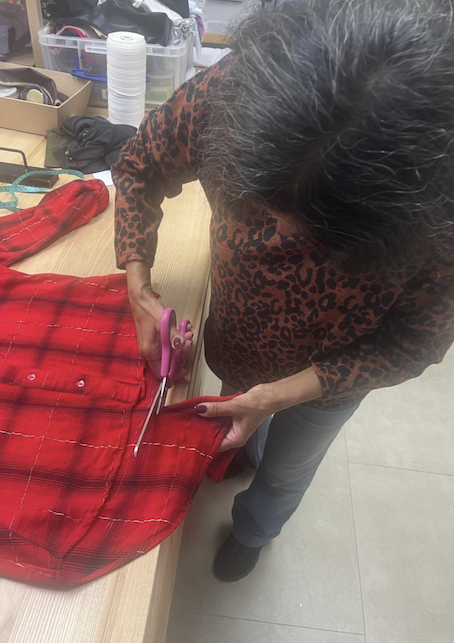
This practical approach is also at the heart of the work being undertaken by Fashion-Enter Ltd. At the FC Designer Collective shop on Fonthill Road in North London, Fashion-Enter continues to run community drop-in workshops every two weeks, supported by Islington Council. The sessions are designed to help people extend the life of garments and household textiles through repair, alteration and potentially upcycling.
The next community session takes place on Tuesday 6th October, giving local residents an opportunity to bring along an item from their wardrobe or home that needs attention.
(Image right: Drop-In Repair and Upcycle free community workshop at the FC Designer Collective shop, 113-115 Fonthill Road, London N4.)
This is exactly the kind of activity that can turn sustainability from an abstract concept into a practical skill. Not everyone needs to become an expert dressmaker. Sometimes sustainability starts with learning how to replace a button, repair a seam, alter a garment so it gets worn again or find a creative way to transform something that might otherwise be discarded.
Fashion-Enter’s FC Designer Workspace also provides regular upcycling, stitching and pattern-cutting classes at its fully equipped North London facility, led by experienced tutors. These courses offer a deeper opportunity for people who want to develop practical making skills and understand how clothing is constructed.
The transition towards a more sustainable fashion landscape will not be achieved solely through new technologies, legislation or changing what retailers put on their shelves. It also requires people to develop the skills and confidence to repair, reuse, remake, share and value clothing differently.
Repair cafés, sewing workshops, clothing swaps, community fashion shows and school-uniform reuse schemes may appear small when considered individually. Collectively, however, they represent a cultural shift away from the idea that fashion begins with buying something new. Sustainable Fashion Week provides a national platform for that shift. The challenge now is to keep the momentum going – turning a week of activity into everyday habits.
To find Sustainable Fashion Week events taking place across the UK: A Single Thread – Sustainable Fashion Week 2026 Events
To explore FashionCapital’s upcoming upcycling, stitching and pattern-cutting courses: FashionCapital on Eventbrite


