


MP Catherine West Pushes The Reshoring Agenda For Fashion and Textiles

17-02-2026


In her recent article for ParliamentNews.co.uk, published 16th February 2026, Catherine West sets out a clear and timely challenge: if government and industry work together, the UK can become the global home of sustainable, quality fashion.
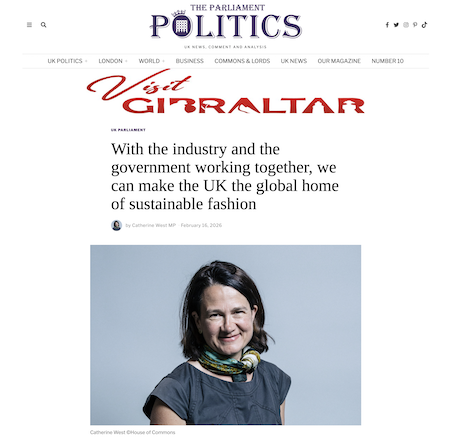
(Catherine West discusses why government and industry need to work together to make the UK the global home of UK fashion – parliamentnews.co.uk)
For those of us at Fashion-Enter Ltd and FashionCapital, this is not a new ambition – it is the very foundation of our work.
Britain’s reputation for craftsmanship, quality and creativity has never disappeared. What changed was the supply chain. Decades of offshoring hollowed out domestic production in pursuit of lower costs, while skills shortages and opaque sourcing models became the norm. Now, with growing demand for transparency and responsible production, reshoring is no longer nostalgic, it is strategic.
West highlights the economic potential of onshoring: billions in GDP, tens of thousands of skilled jobs and significant tax revenues. But beyond the figures lies something more important, the opportunity to rebuild an inclusive economy. One where young people can access technical training, where SMEs are supported through apprenticeship funding, and where public procurement values social impact alongside price.

(A strong commitment to Made in the UK sourcing would strengthen domestic factories, safeguard skilled jobs, boost local economies and deliver meaningful environmental gains.)
This is particularly relevant in light of the Procurement Act 2023, which enables public bodies to prioritise community benefit. Imagine uniforms for the military, NHS or public services consistently made in UK factories operating under fair, transparent conditions. That is not protectionism – it is smart, values-led policy.
Of course, manufacturing in the UK carries costs. But it also delivers accountability, shorter lead times, reduced transport emissions and, crucially, confidence that garments are produced under ethical employment standards. “Made in the UK” should signify both quality and fairness.
At Fashion-Enter, we see daily proof that reshoring works, when training, compliance and production are integrated. The question is no longer whether the UK can lead in sustainable fashion, but whether we are prepared to back the sector at scale.
This is a pivotal moment. With the right government support and industry collaboration, reshoring can strengthen communities, secure skilled jobs and position Britain at the forefront of truly sustainable fashion.


