


Iris van Herpen on AI: “I Don’t Want to Be the AI’s Assistant”
14-07-2026


As Paris Haute Couture Week drew to a close on 9th July, one of the season’s most talked-about collections came from Dutch couturier Iris van Herpen. Renowned for pushing the boundaries between fashion, science and technology, her Autumn/Winter 2026 haute couture collection, Sonic Starquakes, once again demonstrated why she remains one of the industry’s most visionary designers.
Yet despite a career built on innovation, Iris has drawn a clear line when it comes to artificial intelligence. Speaking exclusively to beauty booking platform Fresha following her catwalk show, she revealed that while AI has its place within her studio, it will never replace the deeply personal process behind her designs.
Annabelle Taurua, an expert on Fresha, interviewed Iris, asking how she anticipates AI will incluence couture and her work in the future, Iris explained:
“Well, I think AI is a tool, and it’s really about the way we use it. It’s really important to me that I see AI as a good assistant, but I don’t want to be the AI’s assistant. So that’s the way I use it. I would never invite it into my creative process because that needs to be personal, and it feels sacred as well. It’s who I am. But at the same time, it’s amazing for research, for the scientific R&D behind it, even for text refinements, all of it. So I think you just need to be really conscious in the way you use it.”
The comments reflect a nuanced position from a designer often associated with cutting-edge technology. Rather than rejecting AI outright, Iris embraces it as a practical tool for research, scientific development and administrative tasks, while insisting that the creative spark behind couture must remain inherently human.
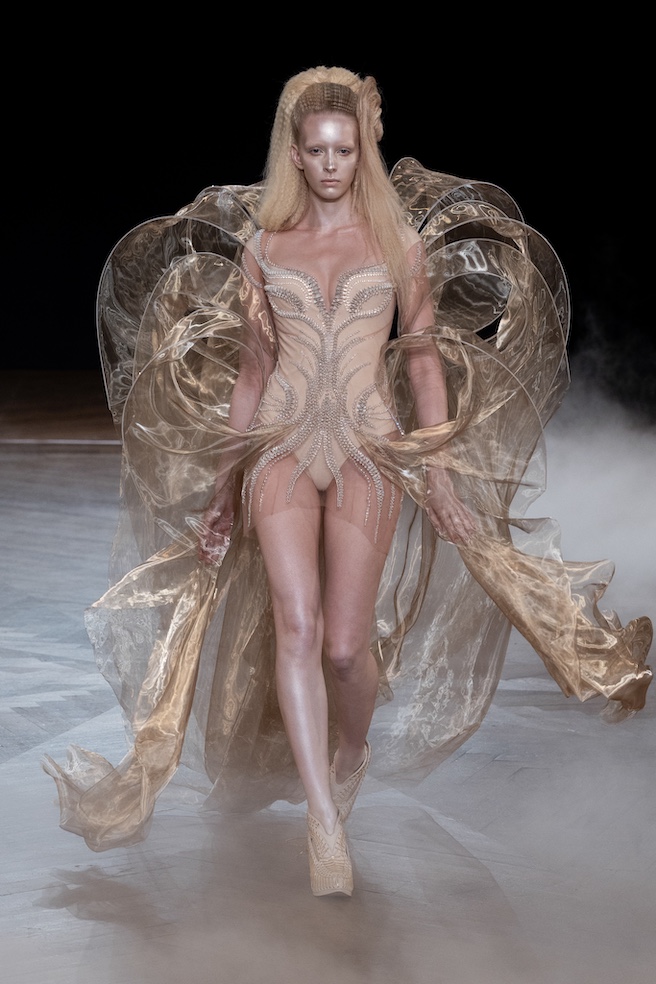
That philosophy is evident throughout Sonic Starquakes, a collection inspired by the hidden vibrations of the universe. Drawing on the phenomenon of starquakes, seismic waves that ripple through stars, alongside exploding supernovae, plasma, galaxies and the mathematics of branching forms, the collection explores the invisible forces that connect the human body with the cosmos.
One of the show’s defining pieces was the Helix Nebula dress, believed to be the first couture garment to incorporate plasma – the fourth state of matter. Featuring two hand-blown glass forms infused with plasma and surrounded by 10,000 individually blown glass spheres suspended on illusion tulle, the dress responds to the wearer’s touch by interacting with the body’s own electromagnetic field.
“For years, I have been drawn to the idea of creating a garment woven from energy alone,” Iris said of the piece. “This is the first time we have worked with the fourth state of matter, plasma.”
Equally captivating was the Fractal Universe dress, which blurred the line between designer and nature itself. After being charged inside a particle accelerator and cryogenically preserved, the garment unexpectedly discharged before it reached the runway, creating branching lightning-like patterns across its surface. Rather than viewing this as a flaw, Iris embraced the spontaneous transformation, allowing natural forces to determine the dress’s final appearance.
The collection continued her fascination with scientific discovery through laser-cut velvets, carbon fibre structures, floating organzas, intricate hand embroidery and more than 30,000 hand-blown iridescent glass spheres. The result was a series of silhouettes that appeared to dissolve into fields of light and energy, challenging traditional ideas of materiality while remaining unmistakably couture.
Despite presenting more than 40 runway collections over nearly two decades, Iris also admitted that the emotional intensity of showing couture has never faded. Although she appears calm backstage, she confessed that “the nerves are on the inside” before every presentation.
That balance between precision, experimentation and emotion perhaps explains her views about AI’s role within fashion. While technology has long shaped her work, she believes creativity itself cannot be outsourced.
In an era where generative AI is increasingly influencing design, for Iris perspective offers an important distinction: innovation should enhance human imagination, not replace it. For one of fashion’s most technologically progressive designers, the future of couture still begins with something no algorithm can replicate…human curiosity, intuition and creativity.
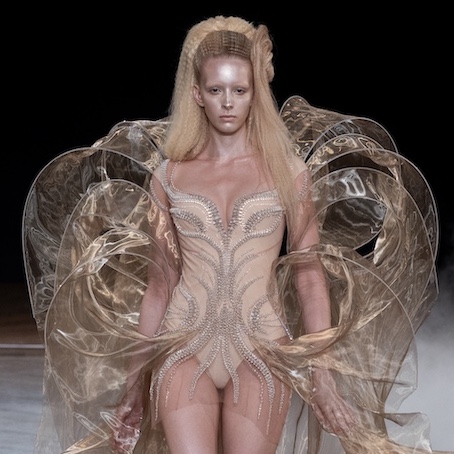
Image from Iris van Herpen Sonic Starquakes collection by Gio Staiano


