


Early or Late Brings Its Art-Led Vision to Life With Fashion-Enter London
15-09-2026


For Early or Late, art is not something that belongs exclusively on a gallery wall. Founded by Firat Celebi and Raul San Martin, the label was created from a shared belief that certain artworks deserve to live beyond traditional exhibition spaces — becoming part of everyday life and creating meaningful connections between art, people and place.
That philosophy is now extending into the way the label makes its garments. Early or Late has partnered with Fashion-Enter Ltd to produce its T-shirts, bringing its first edition to life through a London manufacturing team with decades of experience in pattern cutting, garment construction, production and technical development.
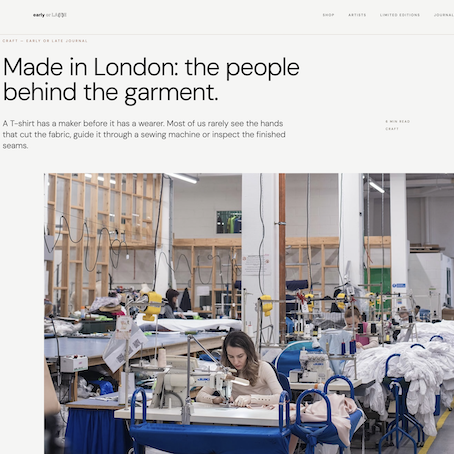
The partnership was recently celebrated by Early or Late through a feature in its online journal, Made in London: the people behind the garment, which takes readers behind the scenes at Fashion-Enter’s factory in Haringey, North London.
Rather than focusing solely on the finished product, the journal explores the people, decisions and craftsmanship that sit behind every garment.
A shared belief in the value of making
There is a natural connection between Early or Late’s approach to art and Fashion-Enter’s approach to manufacturing. Early or Late was founded around the idea of taking art beyond conventional boundaries. Fashion-Enter was founded around the need to bridge the gap between creative ideas and the practical expertise required to turn those ideas into commercially viable garments.
Fashion-Enter’s roots go back to FashionCapital, the online fashion resource launched in 2001. FashionCapital was created to provide emerging designers and businesses with industry news, practical information and advice at a time when the internet was transforming the fashion industry.
One recurring issue became increasingly clear: designers could have strong creative ideas but struggle to find reliable UK manufacturers willing to work with smaller quantities and emerging businesses. That gap led to the creation of Fashion-Enter in 2006 by CEO Jenny Holloway. Almost two decades later, Fashion-Enter continues to combine manufacturing with sampling, technical development, education, apprenticeships, repairs, upcycling and support for emerging designers.
The relationship with Early or Late is therefore particularly fitting. It is another example of a creative business working directly with a UK manufacturer to develop a product carefully, rather than simply placing an order and receiving a finished garment.
Understanding the garment before making it
Early or Late’s journal highlights the importance of the development process, describing how the team at Fashion-Enter supported the label as it refined its two T-shirt silhouettes.
Details including the neckline, topstitching, hems and placement of the artist authentication label were considered and developed before the first production run. This technical dialogue is an important part of Fashion-Enter’s work with emerging and independent brands.
A designer’s original idea is only the beginning. Fabric behaviour, construction methods, pattern shape, machinability, finishing, quality and production quantities all have to be considered if that idea is going to become a successful garment.
Fashion-Enter’s Creative Director, Beth Davy-Day, shared this process with Early or Late during their visit to the London factory, offering insight into what happens between a creative concept and a finished product. For a young brand, this kind of knowledge can be as valuable as the manufacturing itself.
The people behind the garment
One of the most striking elements of Early or Late’s feature is its focus on the people working behind the scenes. A T-shirt may look simple when it reaches a customer, but its construction involves a sequence of skilled decisions. Fabric has to be prepared and cut accurately. Individual components need to be assembled correctly. Seams, hems and finishes have to be checked. The final garment needs to meet the required quality and specification.
At Fashion-Enter, this work is carried out by a diverse team of machinists, cutters, pattern cutters, technicians, production specialists and quality-control staff, many of whom bring years of industry experience. That expertise is increasingly important at a time when UK fashion manufacturing is being asked to do more than simply produce garments.
Fashion-Enter’s factory is also a place where knowledge is passed between generations, with apprentices and learners working alongside experienced professionals and gaining practical insight into the realities of garment production. As Early or Late observed in its journal, manufacturing is ultimately a team effort. The designer brings the vision, but bringing that vision into physical form requires collaboration between pattern cutters, cutters, machinists, technicians and production teams.
Starting small can be a strength
For emerging labels, one of the biggest challenges can be knowing how much to produce. The temptation when launching a collection is often to manufacture as much as possible in order to achieve a lower unit cost. Fashion-Enter’s experience has shown that this is not always the best route for a young business.
Early or Late’s journal highlights Fashion-Enter’s advice around cashflow and stock, with the team encouraging brands to start carefully, test their products and understand their customers before committing to larger production quantities.
It is an important part of the relationship between manufacturer and designer. Manufacturing support is not simply about making what a customer requests. For Fashion-Enter, it can also mean providing honest technical and commercial advice that helps a young brand make better decisions. That approach is particularly relevant to Early or Late, whose first edition is being developed carefully around two core silhouettes rather than an unnecessarily large collection.
Made in London
The partnership also demonstrates the continuing value of London as a place to design and manufacture fashion. Early or Late’s T-shirts are being produced at Fashion-Enter’s factory in Haringey, bringing the creative development and manufacturing process together within the UK.
The label’s journal captures this beautifully by looking beyond the phrase “Made in London” and asking what those words actually mean. They represent a location, but also a team, a set of skills and a series of decisions that determine how a garment is made. For Early or Late, that means its fabric arriving at the Fashion-Enter factory, being measured and cut, assembled into the agreed silhouettes, finished with its artist authentication labels and inspected before leaving the factory. Those details may not always be visible in a product photograph, but they contribute to the quality, longevity and identity of the finished piece.
Fashion and art beyond the gallery wall
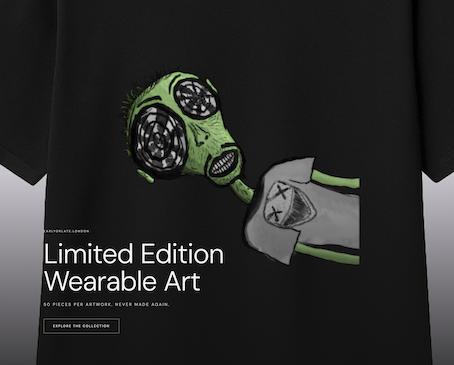
The Early or Late project is an example of how fashion can provide another platform for artists and creative ideas. The T-shirt becomes more than a basic garment. It becomes a vehicle for an artwork, an authentication element and a story about how that piece came into existence. And that story now includes the people who made it.
By choosing to work with Fashion-Enter in London, Early or Late is putting manufacturing into the narrative rather than hiding it behind the finished product. For Fashion-Enter, it is another example of the role that UK manufacturing can play in supporting independent creative businesses – providing not just production capacity, but technical knowledge, guidance and a collaborative environment in which ideas can be developed.
It is also a fitting continuation of the journey that began with FashionCapital more than 20 years ago: connecting creativity with practical knowledge and helping designers turn ideas into products. As Early or Late prepares its first edition for release, the garments carry with them a story that begins with art, passes through design and technical development, and ultimately reaches the hands of the people who make them.
Tap here to view the Early or Late journal feature on FEL
Early or Late will launch with two artists with five original artworks in limited quantities from Autumn 2026.


