


ASBCI Webinar Global Chaos, Local Opportunity: Why UK Manufacturing Is Back in Focus
16-04-2026


In a world defined by disruption, uncertainty has become the new normal for fashion sourcing. From geopolitical instability to rising transport costs and shifting legislation, brands and retailers are being forced to rethink long-established supply chain models.
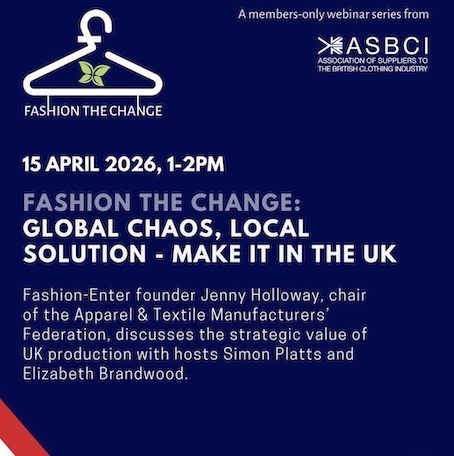
In a recent ASBCI webinar (15th April) introduced by Elizabeth Brandwood titled: “Global Chaos, Local Solution – Make it in the UK”, industry leaders Jenny Holloway and Simon Platts explored how the UK can play a critical role in building more resilient, profitable and responsible sourcing strategies. What emerged was not a call to abandon global sourcing but a clear argument for balance, smarter decision-making, and a renewed appreciation for local capability.
From Cost Price to “Safe Margins”
One of the most important shifts discussed was the need to move beyond a narrow focus on cost price and towards what can be described as “safe margins.”
As Simon Platts explained, the traditional sourcing model, driven by the lowest possible intake price, no longer reflects the true cost of doing business. Hidden risks such as shipping delays, geopolitical disruption, excess stock, markdowns, and returns can quickly erode margins, sometimes turning profit into loss.
Instead, brands should be thinking holistically. A garment produced at a higher initial cost in the UK may ultimately deliver stronger net profit through:
- Higher sell-through rates
- Reduced overproduction
- Faster replenishment
- Lower logistics risk
- Improved transparency
This is where “safe margins” come into play, prioritising reliability and predictability over headline cost. In an era where delays or disruptions can wipe out seasonal relevance, margin protection is increasingly tied to supply chain resilience.

Blended Sourcing: A Smarter Model
Both Holloway and Platts were clear: this is not about re-shoring everything to the UK. Instead, the future lies in blended sourcing strategies.
This approach combines global production with local manufacturing to create a more agile and responsive supply chain. The UK’s role within this model is not to compete on volume or lowest cost, but to complement offshore production with speed, flexibility and proximity.
Blended sourcing enables brands to:
- Place core, high-volume orders offshore
- Use UK manufacturers for shorter runs and reactive production
- Test new products with lower risk
- Replenish bestsellers quickly
Crucially, it introduces the concept of “just in time” ordering – a capability that UK manufacturing is uniquely positioned to support. With production close to market, brands can respond to real-time demand rather than relying on long-range forecasts that often lead to overproduction.
As Holloway highlighted, the issue in the UK is not a lack of skill but a lack of consistent orders. Leicester alone has a highly skilled workforce ready to deliver, with manufacturers capable of adapting across product categories. The opportunity is there, but it requires commitment from brands.
Near-shoring in Turbulent Times
The webinar repeatedly returned to the theme of instability, what Platts described as a constant backdrop of “war, famine, fire” affecting global trade routes and supply chains.
In this context, near-shoring, bringing production closer to home, becomes less of a trend and more of a necessity.
The UK offers several advantages in turbulent times:
- Reduced dependency on complex international logistics
- Faster lead times and greater flexibility
- Easier communication and oversight
- Greater supply chain transparency
Holloway introduced the idea of “safe-shoring” – a natural evolution of near-shoring. It’s not just about geography, but about reliability. If a product cannot arrive on time or in the right condition, its lower cost becomes irrelevant.
Late deliveries can result in missed seasons, heavy discounting, and lost revenue. In contrast, UK production offers control and cadence, key ingredients for maintaining profitability in volatile markets.
The Power of Just-in-Time and Reduced Waste
A major benefit of incorporating UK manufacturing into sourcing strategies is the ability to shift towards demand-led production.
Rather than committing to large volumes upfront, often with a built-in expectation of markdown (sometimes as high as 35%), brands can produce closer to need. This reduces waste, improves cash flow, and aligns more closely with sustainability goals.
Holloway was particularly direct on this point: overproduction is not just inefficient – it’s outdated. Producing less, but smarter, is both commercially and environmentally beneficial.
This model also aligns with incoming legislation around waste, overproduction and carbon impact. With potential taxes on transport and stricter sustainability requirements on the horizon, local production offers a practical way to future-proof operations.
Relationships and Industry Change
Beyond strategy and economics, one of the most striking aspects of the webinar was the rapport between Jenny Holloway and Simon Platts. Their conversation reflected years of shared experience, mutual respect, and a common goal: to build a stronger UK fashion and textile industry.
They spoke candidly about the importance of relationships, something often overlooked in modern sourcing. Strong partnerships between brands and manufacturers can unlock efficiencies, improve communication and ultimately deliver better commercial outcomes.
Platts emphasised that collaboration, not aggressive cost negotiation, is where real value lies. As he put it, there is “far more value in carrot than stick.”
Holloway echoed this, highlighting the need for unity within UK manufacturing itself, encouraging factories to work together rather than compete on price alone.
Their shared passion was clear: this is not just about business, but about rebuilding an industry, supporting communities and creating long-term opportunity.
A Defining Moment for UK Manufacturing
The message from the webinar was unmistakable: the conditions for change are already here.
- Global instability is not going away
- Legislation will increase pressure on traditional models
- Consumers are becoming more conscious
- Technology is enabling new ways of working
Against this backdrop, the UK offers a compelling solution – not as a replacement for global sourcing, but as a critical part of a more resilient, balanced approach.
The challenge now lies with brands and retailers. As both speakers stressed, this shift requires commitment from the top – particularly from C-suite leaders who must rethink how value, cost and risk are measured.
The opportunity is immediate, but it will not remain open indefinitely. As demand for local manufacturing grows, capacity will tighten.
As Platts put it simply: “It’s now or never.”
Continuing the Conversation at Leicester Made & Regions 2026

These themes will move from discussion to action at Leicester Made & Regions 2026, taking place on Friday 24th April at De Montfort University. Bringing together manufacturers, brands, policymakers and industry experts, the event offers a unique opportunity to explore how blended sourcing, near-shoring and UK production can be implemented in practice.
With its focus on real-world solutions, trusted partnerships and future-facing strategy, Leicester Made and Regions provides the perfect platform to build the relationships and understanding needed to navigate today’s challenges. For any brand or retailer rethinking their sourcing model, it is not just an event, it is a timely opportunity to engage with the people and ideas shaping the future of UK fashion and textiles.
Tap here to find out more and register to attend Leicester Made and Regions 2026


