


Made in Britain, Made in London: A Morning Inside the Small Factories
06-11-2026


Guest author Olivia Harrison discovers that UK fashion and textile production is far from over with the rise of small UK factories…
On a cold Tuesday morning in Haringey, I watched a woman called Rosa mark a dress pattern with a piece of chalk. She did not rush. She checked the same line three times, held the cloth up to the light, and only then picked up her scissors. “If I cut it wrong, we all pay for it,” she said, and laughed. The dress she was cutting would be on sale in a small London shop in less than three weeks.
And more brands are choosing this way of making again.
Inside a London sampling studio — the pattern comes first.
First, the pattern has to be right
Every garment starts as a flat shape on paper or card. This is the pattern cutter’s job, and it is skilled work.
Rosa works with a small team at a sampling studio in east London, where new styles are made for the first time. A designer brings a sketch and some fabric. Rosa makes the pattern. A machinist sews one garment. Then everyone stands around it and talks. The sleeve is tight. The hem pulls. The pocket sits too low.
In a big overseas factory, fixing those faults can take weeks of emails and posted parcels. Here, Rosa moved the pocket in ten minutes, and the second sample was sewn the same afternoon.
Have you ever tried on a dress that looked perfect on the hanger and wrong on you? That is often a pattern problem, and it is fixed by hands like Rosa’s, not by software alone.
Then the small factory floor takes over
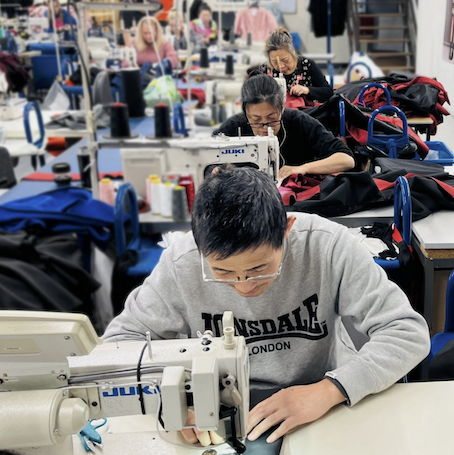
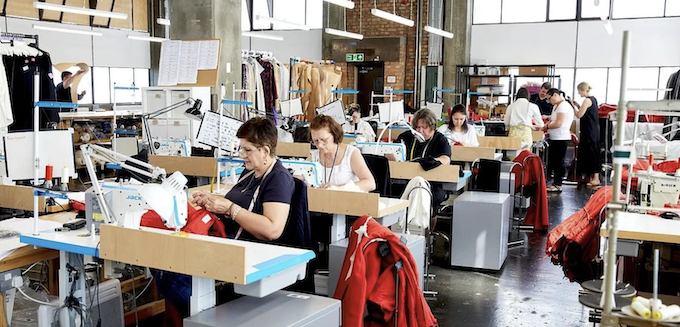
A few miles north, in Haringey, sits Fashion-Enter — a working garment factory where CMT, that is cut, make and trim, the three steps of turning cloth into clothes, happens under one roof. Rows of machines, steam presses, and rails of half-finished dresses fill the floor, and most weeks a few hundred pieces go out of the door across many small styles.
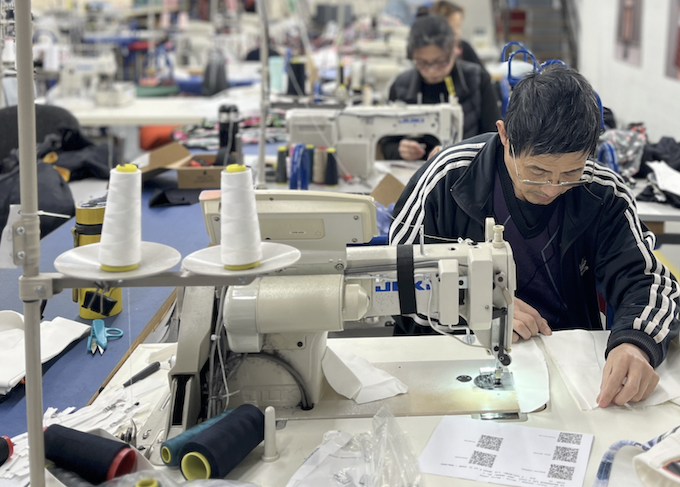
Small runs on the factory floor: cut, make and trim under one roof.
That is a small number. A large factory overseas may ask for 3,000 pieces of one style before it will even start. Here, a young brand can order 80 dresses, sell them and order 80 more in a new colour.
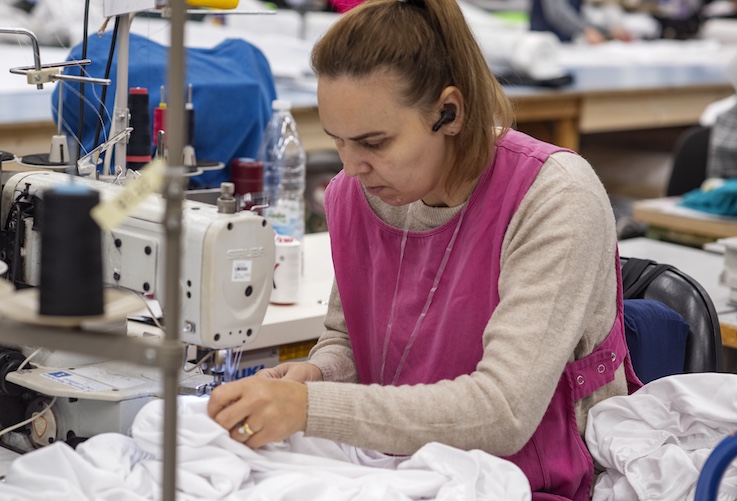
The owner walks the floor all day. If a seam looks weak, she stops the line and shows the machinist again. One machinist, Tomas, has sewn the same brand’s coats for four years. “If the lining is not right, I feel it in my fingers,” he said.
Quality, in a place like this, is not a form you fill in. It is a person who notices.
Short runs, old skills
Not all of the work is dresses and coats, and not all of it is in London. In Derbyshire, John Smedley has made fine knitwear in the same valley since 1784, and workers there still link jumper pieces together by hand, one stitch at a time. Linking is slow. A hand-linked seam moves with the body, and the jumper lasts longer.
Back in London, on Savile Row, Dege & Skinner has cut bespoke suits by hand since 1865, and its tailors still sew some buttonholes by hand. “A machine does it in nine seconds,” one of them said. “I take four minutes. But mine will still be there in ten years.”
Hand-finishing is slow — and it is why the garment lasts.
These skills nearly died in Britain. In the 1980s and 1990s, most making moved abroad and whole streets of workshops closed. The people who stayed kept the skills alive in small rooms like these. Now their problem is the opposite one. There is work again, but not enough young people learning how to do it. They need trainees more than they need orders.
So why are brands coming back?
So what changed? The honest answer is cost, but not in the way people expect. Making in London costs more per piece. Nobody hides that. A dress that costs £6 to sew overseas may cost £14 to sew here.
But the full bill tells a different story. There is no six-week wait for a ship. There are no 2,000 extra dresses sitting in a warehouse because a style did not sell. A brand can test a style with 60 pieces, and reorder only the sizes and colours that moved. One designer told me her waste stock fell by half in the year she moved her making back to London.
Customers ask more questions than they used to. They want to know where a garment was made, and by whom. A label that can answer plainly — made in London, in a named workshop, by people paid fairly — has something real to say. Our guide to starting sampling and production in London covers the first steps.
One London maker put it in simple words. “We are not the cheapest,” she said. “We are the closest. The designer stands next to us. Nothing is hidden.” It is no accident that Fashion-Enter also runs a training academy on the same site — the skills have to be passed on, or the closeness disappears with the people who hold them.
The chalk line again
Late in the day, I thought about Rosa and her chalk line. She is making a few hundred dresses for people who will wear them a few streets away.
That is what “Made in Britain” means in real life. Not a flag on a label. Just skilled people, small rooms, short distances — and a dress that fits, because someone checked the line three times before she cut.


