


Shockat Adam MP Continues To Champion Leicester’s Textile Industry on BBC Politics East Midlands
20-10-2026


Leicester’s textile and garment manufacturing industry has received another welcome spotlight following Shockat Adam MP’s appearance on BBC Politics East Midlands on 18th October 2026.
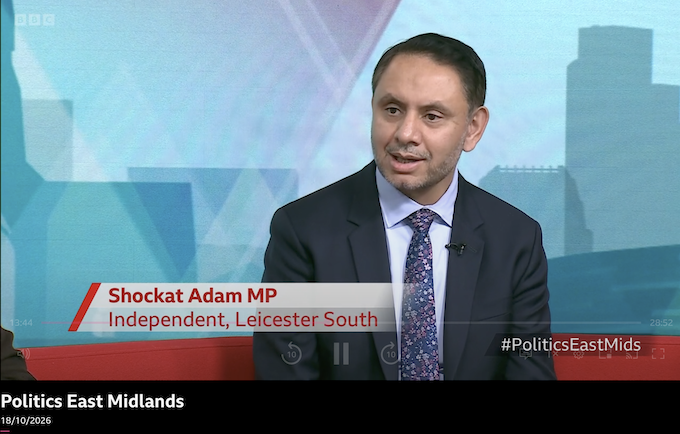
(Courtesy of BBC Politics East Midlands)
The Leicester MP is campaigning for a greater proportion of government contracts to be awarded to British manufacturers, arguing that public money should support domestic industry, protect skilled employment and help rebuild the UK’s manufacturing capabilities. The programme, featuring Leicester political reporter Dan Martin, explored the scale of the opportunity for local businesses and asked whether Leicester could secure a greater share of the estimated £90 billion in government contracts highlighted in the report.
Fashion-Enter Ltd and the Apparel & Textile Manufacturers Federation (ATMF) have been supporting this agenda in unison, championing responsible UK manufacturing, skills development and fair opportunities for British businesses. Their shared position is that public procurement should recognise the value of domestic production and give capable UK manufacturers a genuine opportunity to compete for contracts that have too often been awarded overseas.
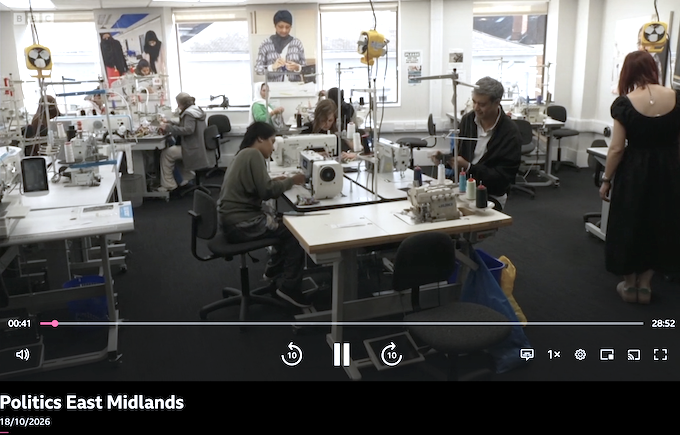
(Courtesy of BBC Politics East Midlands – FTA Leicester)
The BBC report visited Leicester’s Fashion Technology Academy, where a new generation of textile workers is developing the practical skills needed to support the future of the industry. Jenny Holloway, CEO of Fashion-Enter Ltd, spoke candidly about the pressures facing UK manufacturers, highlighting the high costs of employment and energy while emphasising the quality and speed of production that British factories can offer.
“It’s a very challenging time as we have labour rates at £12.71 minimum pay, which is the fourth highest in the whole of Europe. We also have very high energy costs, I think we are the highest in Europe, but no one can compete on our quality and our lead time,” Jenny explained.
Her comments underline the difficult balance facing British manufacturers. Businesses must meet rising operating costs, pay workers fairly and maintain responsible working practices while competing with international supply chains that may benefit from significantly different cost structures. However, Leicester’s established manufacturing expertise, experienced workforce, quality standards and shorter lead times offer clear advantages that deserve greater recognition in public procurement decisions.
Shockat Adam has been making the case that government purchasing should be used more strategically to support British industry. The principle is straightforward: when UK manufacturers have the skills and capacity to deliver, public bodies should ensure that domestic suppliers have a fair opportunity to compete. The objective is not simply to bring orders back to Britain, but to create a stronger, more sustainable manufacturing base that can support employment, investment and economic growth.
The campaign also addresses the reputational challenges Leicester’s garment industry has faced following allegations of poor wages and working conditions. Shockat Adam highlighted the findings he attributed to the government’s Operation Tacit Report of the sector, arguing that the actions of a minority should not define the many manufacturers operating responsibly. For ethical businesses, the challenge is to rebuild confidence while demonstrating that quality production, fair employment and commercial success can go hand in hand.
Fashion-Enter Ltd and ATMF share the view that increased access to public contracts must be accompanied by accountability and transparency. A credible code of conduct or recognised verification scheme could help public-sector buyers identify manufacturers that meet appropriate employment and operational standards. Such an approach would reward responsible businesses, protect workers and help ensure that public money supports manufacturers committed to ethical production.
The programme also highlighted the complexity of the government procurement process, particularly for small and medium-sized enterprises (SMEs). Shockat Adam explained that a consortium of 20 companies had been established to bid for a multi-million-pound military uniform contract, providing an example of how manufacturers can collaborate to pursue opportunities that might otherwise be beyond their individual reach. He also pointed to the difficulties businesses face in identifying the right departments and decision-makers, describing procurement as a labyrinth that can prevent capable local companies from competing on a level footing.
For Leicester’s manufacturers, simplifying access to procurement opportunities could make a significant difference. Clearer information about forthcoming contracts, accessible tendering processes, practical guidance and opportunities to collaborate would help businesses demonstrate their capabilities. It would also enable public bodies to engage with a wider range of suppliers and consider the longer-term benefits of investing in domestic production.
The importance of this approach was reflected in the programme’s cross-party contributions. Cllr Ben Taylor, Conservative leader of Blaby District Council, expressed support for the campaign, agreeing that helping British businesses succeed could create a positive ripple effect across the region. Cllr Nadine Peatfield, Labour leader of Derby City Council, also spoke about the renewed recognition of British industry and the importance of working together to create further opportunities for domestic manufacturing.
This political support reinforces the need for practical action. Procurement decisions can influence not only individual businesses but also employment, skills, local supply chains and the resilience of strategically important industries. In textiles and clothing, maintaining a strong domestic manufacturing base can also provide benefits through shorter lead times, closer communication, greater visibility of working conditions and a more responsive supply chain.
The economic case is particularly relevant when considering value for money. The lowest initial price does not always represent the best overall value when quality, reliability, delivery times, employment and the wider economic contribution are taken into account. A procurement framework that properly assesses these factors could help public bodies make informed decisions while giving British manufacturers a fair opportunity to compete.
Shockat Adam’s appearance on BBC Politics East Midlands forms part of a wider campaign to revive Leicester’s textile heritage. In a post on X on 6th March 2026, he reflected on the city’s history, writing: “Leicester once clothed the world.” He went on to highlight the loss of domestic production and skills as garments increasingly arrive from thousands of miles away, reaffirming his commitment to local manufacturing, fair work and sustainability.
On 13th June 2026, he strengthened his call for government action, stating: “If this Government is serious about British business, it should start by backing it.” He argued that textile public procurement contracts should not be routinely sent overseas when a skilled workforce already exists in places such as Leicester, ready and able to deliver.
His campaign also recognises that manufacturers need fair commercial relationships beyond public procurement. On 24th September 2026, Shockat Adam voiced support for calls for a Fashion Watchdog to address practices that can leave manufacturers vulnerable to last-minute order changes, renegotiated prices and late payments. These pressures can undermine businesses even when they have the skills and capacity to produce high-quality garments. Fairer commercial relationships are therefore an important part of building a sustainable UK fashion and textile industry.
For Fashion-Enter Ltd and ATMF, the priorities are closely connected: supporting responsible manufacturing, investing in skills, improving access to contracts and creating the conditions for British businesses to thrive. The Fashion Technology Academy is central to this ambition, helping develop the skilled workforce required to meet future demand and ensuring that manufacturing knowledge is passed on to a new generation.
Leicester has the expertise, infrastructure and manufacturing heritage to play an important role in the future of British textiles. The challenge is to connect those strengths with a procurement system that allows local businesses to compete effectively and recognises the wider benefits of domestic production. The proposed military uniform consortium demonstrates the potential of manufacturers working together, while the growing political discussion provides an opportunity to turn support for British industry into tangible outcomes.
As Shockat Adam stated during the programme, “We should never give up on home-grown industries. Businesses can thrive in this country.”
Tap here to view BBC Politics East Midlands – available for 28 days.


