


London Fashion Week SS27: The Directions to Watch
29-09-2026


From textile reuse and precision craft to cultural identity, exposed midriffs and sculptural silhouettes, London’s emerging designers are pointing towards a fashion future that values individuality, longevity and making over fleeting trends. There is a temptation after every Fashion Week to ask the same question: what are next season’s trends? However, “trend” is no longer the most useful word. Trend implies speed — something appears, peaks and disappears, replaced by the next visual idea.
What emerged from London Fashion Week for SS27 feels rather different. Across a cohort of emerging and independent designers, there was evidence of direction: a movement towards fashion that is materially intelligent, technically precise, culturally rooted and designed to have a life beyond a single season.
London Fashion Week, which ran from 17th – 21st September, brought established names back to the capital alongside a strong cohort of emerging designers. Looking beyond the headline shows, several ideas appeared repeatedly.
(Reuse – SDCA Studio SS27)
1. Reuse becomes a design language
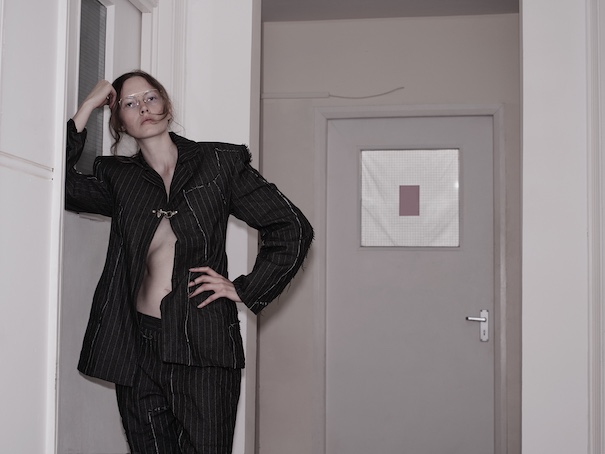
Sustainability is increasingly visible in the garment itself rather than presented as a separate message. SDCA Studio’s SS27 Rebirth collection is a clear example, combining previous-collection materials, deadstock, natural textiles and textile scraps with minimal-waste pattern cutting. The presentation even included the live creation of a dress from leftover materials.
Here, fraying, piecing, reconstruction and visible intervention become part of the aesthetic. The history of the material becomes part of the design.
(Midriff – Ray Chu SS27)
2. The torso takes centre stage
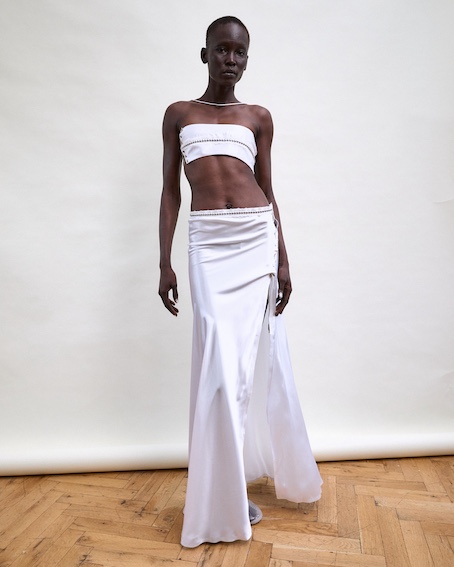
Bras, bra tops, exposed midriffs and silhouettes that deliberately draw attention to the bust appeared repeatedly across the season.
Rather than simply reading as underwear-as-outerwear, the focus on breasts and midriff feels part of a wider return to the body as a key design element. Skin, structure and fabric are being used together to create silhouettes that feel both revealing and constructed.
At the other end of the spectrum, midi lengths were also notable — creating a more elongated, considered silhouette and offering an alternative to the dominance of either mini or floor-length dressing.
3. Precision replaces perfection
Poet-Lab describes its design language through geometric, minimalist silhouettes, architectural structure and precise form, while Infdark’s SS27 Macro places emphasis on detail, proportion and construction.
At a time when fashion imagery can be generated and replicated almost instantaneously, physical making becomes a form of authorship. Handwork, construction, texture and the relationship between fabric and body all become visible.
The repeated appearance of unfinished hems, hand draping, patchwork, mixed fabrics and intricate construction across LFW reinforced this idea.
4. Surface becomes the story
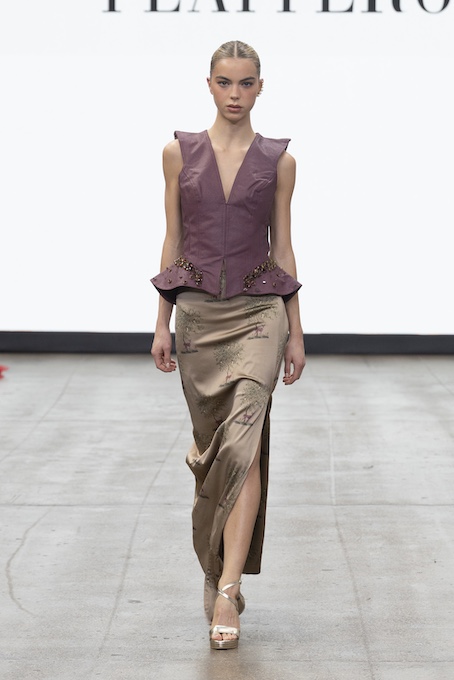
Embellishment, decoration and surface detail were everywhere — from embroidery and beading to sequins, feathers, fringe, appliqué and handmade interventions.
Flapper6 brought Rabari embroidery, leatherwork and beading into a contemporary London context, while Rocky Star’s occasionwear was built around elaborate surfaces and hours of detailed craftsmanship.
This is maximalism with a purpose. When fashion is abundant and increasingly easy to reproduce, the time, skill and individuality embedded in a garment become part of its value.
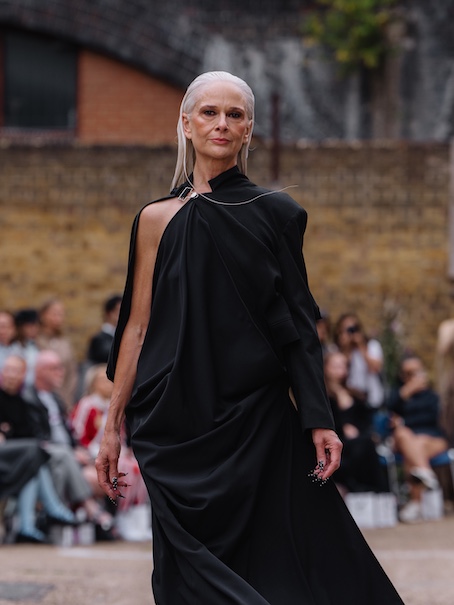
(Hard/soft Poet-Lab SS27)
5. Hard meets soft
Another recurring silhouette combined tailoring and structure with gathers, volume and softness. Sharp jackets and constructed forms were softened by gathered fabrics, fluid shapes and exaggerated volume. The contrast — hard against soft, fitted against full, architectural against romantic — created silhouettes that felt less rigid and more dimensional.
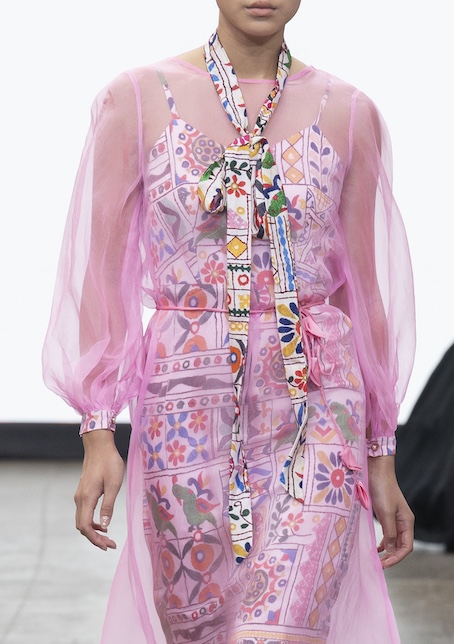
6. Craft becomes contemporary
Flapper6 demonstrates how traditional craft can move forward rather than simply look backwards. Sonal Desai’s collection brought Indian embroidery, leatherwork and handwork into contemporary silhouettes, while Apu Jan continues to build collections around pattern, knitwear, traditional references, fantasy and narrative.
Here, craft is not simply a marker of heritage. It becomes a form of design intelligence, bringing specialist knowledge, time and individuality into the finished garment.
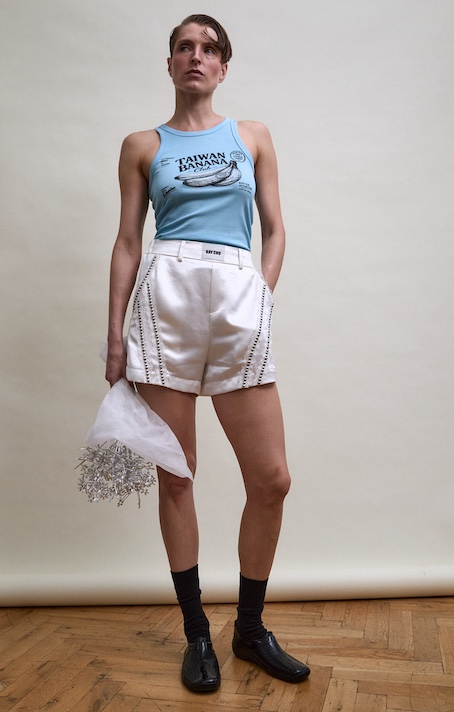
(Cultural – Ray Chu SS27)
7. Cultural identity becomes material
Ray Chu’s SS27 Fans Only Club drew on Taiwan’s Sambucus flower, translating its clustered botanical form into gender-fluid tailoring, translucent layers, body-conscious silhouettes, prints and embellishment.
The collection also incorporated Swarovski ReCreated crystals, produced from crystal manufacturing breakage, bringing material reuse into the mix. The result is a useful model for how cultural identity can inform contemporary fashion without becoming literal or costume-like.
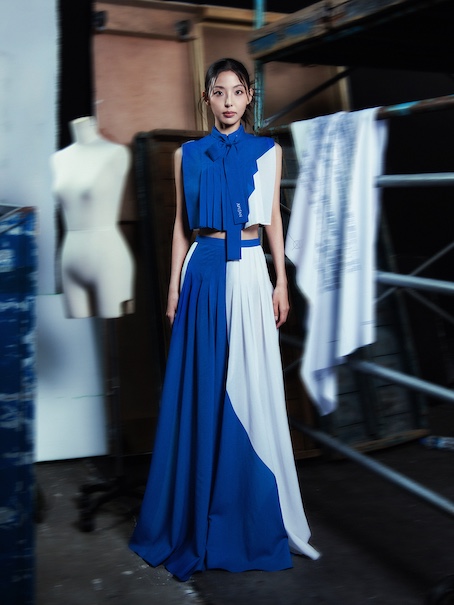
(Blue – Apu Jan SS27)
8. Colour moves beyond the season
If one colour story kept recurring, it was less a single shade than a spectrum: blue in almost every incarnation, alongside rich berry tones, with black, white, neutrals and softer pastels providing contrast.
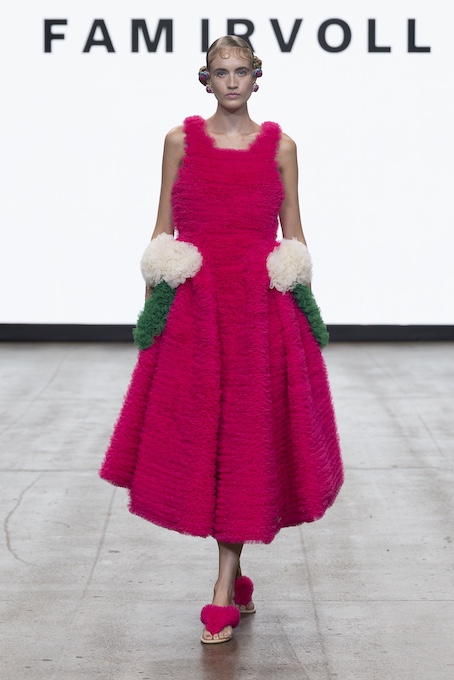
Flapper6 moved between bright and pastel shades, neutrals and jewel tones. Ray Chu worked with the delicate whites of the Sambucus flower and soft pastels, while Fam Irvoll brought an exuberant colour language to its club-culture-inspired world.
The common thread is that colour is increasingly being used to build identity and emotion rather than simply satisfy a seasonal palette.
9. Maximalism has staying power
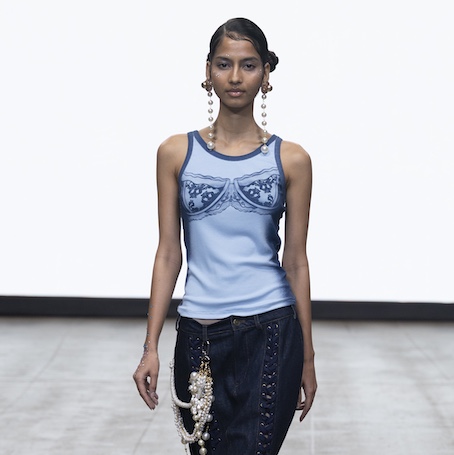
Sustainability does not necessarily mean restraint. Fam Irvoll’s SS27 Original Partymonster revisited the designer’s relationship with early-2000s London club culture through bold prints, sporty silhouettes, sculptural elements, recycled denim, mesh, embroidery and handmade pieces.
The same principle can be seen in Rocky Star’s elaborate embellishment. Longevity can come from emotional attachment as much as material choice. A garment that feels highly individual, technically accomplished or intensely personal may have a life beyond a single season because it does not feel disposable.
10. London remains the laboratory
Perhaps the biggest direction is London itself. Taiwanese identity in Ray Chu, Indian craftsmanship in Flapper6 and Rocky Star, the fantastical world of Apu Jan, London club culture in Fam Irvoll and the material experimentation of SDCA Studio all sit alongside one another. That collision is what continues to make London distinctive.
The emerging designers of SS27 are not simply proposing another set of colours, shapes or products to consume for one season. They are asking different questions: how should fashion be made? What can we reuse? How can craft evolve? How does culture become design? And what makes someone want to keep a garment?
Perhaps, then, “directions” is more useful than “trends”. Because the most interesting thing coming out of London for SS27 is not necessarily what we will all be wearing next summer. It is a broader shift towards fashion that is more personal, more physical and more considered and, crucially, made to matter for longer than a season.
Top image by Fam Irvoll


