


From the Red Carpet to the Gridiron: The Evolving Style of the Modern Athlete
03-09-2026


The Death of the Team Logo
Fans used to bleed for the logo on the front of the jersey. Today, they are cashing tickets based purely on the name stitched across the back. The commercial architecture of professional sports has completely fractured. We are witnessing the death of the collective franchise and the aggressive rise of the hyper-individualized athlete. Look closer at the modern sports landscape. A player is no longer just a roster spot; they are a standalone cultural and financial institution. This pivot isn’t happening by accident. Executives meticulously engineer this shift on concrete tunnel runways before tip-off. Sportsbooks then aggressively monetize the momentum through micro-markets before the opening snap.
The Malicious Compliance of 2005
The front office panicked back in 2005. Executives watched the brawl in Detroit and immediately slapped a strict dress code on the entire roster. Everyone in the building understood the unspoken motive—scrub the baggier, street-level aesthetics out of the broadcast entirely. Throwback jerseys, tilted New Era caps, and durags vanished overnight under threat of severe fines. The mandate demanded conservative business attire for all
official league business. Players naturally hated the restriction. The underlying racial profiling of equating streetwear with unprofessionalism was obvious to anyone paying attention.
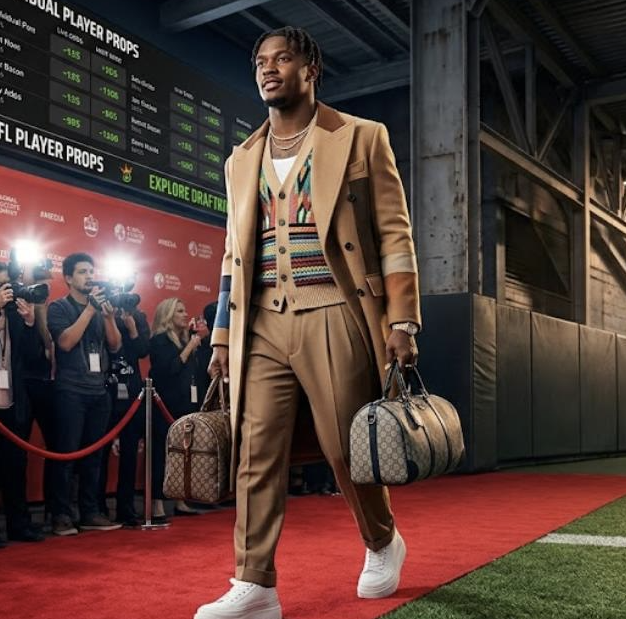
The resistance came dressed in custom tailoring. Rather than fold into quiet middle-management compliance, guys weaponized the mandate. They looked at that bleak, cinderblock hallway connecting the VIP lot to the locker room and decided to treat it like a runway in Milan. Suddenly, you had entire rosters showing up draped in bespoke Gucci or Thom Browne. The league wanted middle-management khakis. Players gave them avant-garde haute couture. That aesthetic rebellion laid the financial groundwork for every modern draft class.
Selling the Linings at the Point State Park Red Carpet
Look at the spectacle of the 2026 NFL Draft out in Pittsburgh. The days of rookies showing up in off-the-rack department store suits are ancient history. Seventeen first-round prospects hit the 250-foot red carpet at Point State Park treating the event exactly like the Met Gala. This is the official, global incubation chamber for the “franchise of one.”
The real money is now hidden inside the jacket. Custom suit linings operate as intimate billboards for immediate corporate monetization and personal branding. Arvell Reese physically opened his blazer for the cameras to reveal a custom interior sponsored by Reese’s candy. Jeremiyah Love inked a formal partnership with Sharpie to showcase custom anime art on his lining. Other players leveraged the space for deep cultural homage. Francis Mauigoa paired a custom-made jacket with a handcrafted Ula Fala Hawaiian necklace to honor his Samoan heritage. Colton Hood lined a cobalt blue suit with a massive photo collage of family and friends.
These teenagers operate as highly sophisticated independent contractors. They understand exactly how to maximize their leverage on a night when millions of eyeballs evaluate their individual worth. All of this happens completely independent of whatever team eventually drafts them. Other prospects bypassed the corporate route to signal raw wealth. Kadyn Proctor flashed a massive custom “Big Gorilla” diamond chain and grills that perfectly matched the vibrant aesthetic of South Beach before heading to Miami.
The End of the Hollywood Mannequin
The old guard of European fashion eventually caught on. For decades, executives at Dior or Louis Vuitton would just write a check to whichever Hollywood actor had a movie out. That was the entire global marketing strategy. The catch? Consumers stopped buying the manufactured studio press tour look. People increasingly perceive actors as highly paid
mannequins forced into outfits by PR teams. Athletes project raw authenticity. Long before Kering or LVMH started cutting their checks, these guys spent their massive contracts on high-end luxury goods organically.
An elite point guard walking into an arena carrying a Louis Vuitton duffel makes the endorsement feel earned. The global fashion market realized they aren’t just selling silk and leather anymore. They sell the psychological dominance and meritocratic success of the alpha athlete.
Prep Made Current (and Highly Profitable)
No one proves this financial ceiling better than Travis Kelce. The Kansas City Chiefs tight end just effectively took over Tommy Hilfiger. They crowned him a Global Brand Ambassador for a massive rollout called “Prep Made Current,” but we should be brutally honest about the corporate strategy at play. Corporate marketers are just dusting off a proven formula. Hilfiger executives saved their brand in the nineties by hitching a ride on the raw cultural momentum of rappers like Grand Puba. They needed authentic street cachet to move products.
The modern tight end or point guard dictates global taste. Kelce refused to just smile for a billboard in Times Square; the man actually negotiated his way into co-designing the entire Spring 2027 capsule. He leveraged a decade of catching passes over the middle into total creative equity. He successfully operates at the exact intersection of fashion, media, and athletic dominance.
The Micro-Betting Engine Funding the Runway
All of this intense visual branding feeds directly into the real financial anchor of the modern sports economy. Fans aren’t just double-tapping a pre-game outfit on Instagram. They open their sportsbooks to invest real capital into that specific human being. The widespread legalization of sports wagering shifted the market violently away from traditional team-based spreads. We firmly live in the era of the micro-wager.
This is where the ecosystem closes its loop. A bettor tracking Kelce’s latest tunnel fit and listening to his podcast is primed to fire up the DraftKings app. That user isn’t just placing a generic bet. They will scour the board specifically hunting for NFL player props to exploit. Maybe they lock in Kelce for an anytime touchdown. Perhaps they bank on him clearing 75.5 receiving yards. Whether the Chiefs win or lose the actual game is entirely irrelevant to that specific ticket. DraftKings and other platforms know this reality intimately. Consequently, they now offer upwards of 500 individual statistical markets per football game, creating an unprecedented depth of engagement.
Users want to script the game themselves. A bettor might build a custom slip demanding four grabs from an elite tight end alongside a specific yardage total for the backup running back. That specific financial exposure transforms a mundane first-quarter screen pass into an absolute heart attack for the viewer. DraftKings leans heavily into this obsession. The platform allows users to combine up to 25 different statistical categories into these hyper-personalized slips. The consumer effectively creates their own customized game within the game, insulating themselves from the actual scoreboard.
High Fashion and Hardwood Prop Slips
The mechanism of individualized financialization is completely gender-agnostic. The WNBA aggressively adopted and perfected this exact blueprint over the last three seasons. Tunnel walks in New York and Las Vegas now command heavy coverage from major fashion publications like Vogue and GQ. Top-tier players show up to Vegas or Barclays Center wearing archival designer pieces—fits that immediately dominate the timeline before warmups even start. Executives quickly figured out that sideline fashion acts as an aggressive multiplier for fan engagement.
Consequently, betting platforms dramatically expanded their WNBA offerings to capture this localized cultural gravity. A fan watching the New York Liberty is just as likely to sweat out a ticket for Breanna Stewart’s individual rebounding total as they are a traditional moneyline wager. DraftKings reported a massive surge in women’s basketball handle precisely because the league leaned into individual star power. The formula remains universally effective. Fashion drives individual identity. That identity directly drives individual betting volume across all demographics.
The Ultimate Feedback Loop
The math is straightforward and incredibly lucrative. A player curates a bold aesthetic identity on the red carpet. Digital media amplifies that identity to a global audience. Luxury brands pay the player to wear their garments. That massive mainstream visibility drives fans to place individual wagers on the player’s statistical output. When an athlete hits those yards or scores that touchdown, the bettor gets paid directly. This cements a fierce, hyper-individualized loyalty that no marketing campaign could ever buy.
Franchise owners slowly realize their historical grip is slipping. Teams operate as little more than logistical hosts for 53 individual mega-brands. The broadcast networks are next in line for disruption. Play-by-play commentary focusing on standard team strategy is obsolete for a viewer sweating out a massive same-game parlay focused entirely on individual receiving yards and rushing attempts. The immediate future of the sports broadcast is a customizable
digital overlay. It will track your financial investments in a player’s performance right next to a clickable link to buy the exact designer suit they wore into the stadium.
Logos die.
The man wearing the helmet is the only asset that counts.
Image Credit – Gemini


