


New Report Calls for Urgent Reform to Support UK Fashion and Textiles Manufacturing
11-05-2026


A new report by Tamara Cincik, FashionRoundtable CEO & Founder, as part of her Fellowship with the Local Policy Innovation Partnership Hub, led by City-REDI at the University of Birmingham, has warned that the UK fashion and textiles sector is facing growing instability despite its major economic, cultural and social contribution.
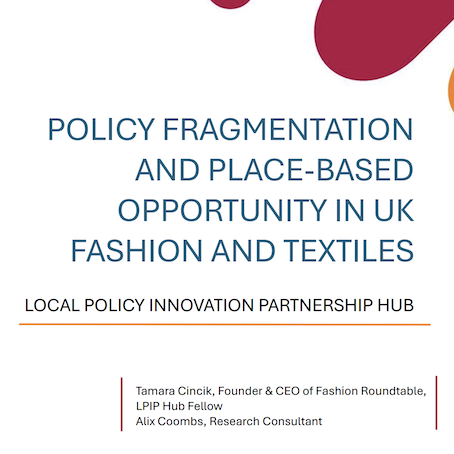
The report: Policy Fragmentation and Place-Based Opportunity in UK Fashion and Textiles explores how fashion and textiles are recognised within UK national, devolved and local government policy. It argues that fragmented decision-making, inconsistent industrial strategies and short-term policy interventions are weakening the sector’s long-term future.
Based on policy analysis, stakeholder mapping and 19 in-depth industry interviews, the report highlights a growing disconnect between government ambition and the everyday reality facing businesses.
While policymakers increasingly talk about reshoring, supply chain resilience and sustainable growth, many SMEs, manufacturers and industry organisations continue to struggle with declining revenues, unpredictable demand and limited access to long-term contracts in the wake of Brexit and the Covid-19 pandemic.
One of the report’s central findings is that fashion and textiles fall between two policy areas: the creative industries and manufacturing. Creative industries policy often focuses on design, branding, intellectual property and exports, while manufacturing policy prioritises high-tech and capital-intensive sectors. This leaves labour-intensive UK fashion manufacturing overlooked within both agendas.
The report identifies public procurement as one of the biggest untapped opportunities for supporting the sector. Industry interviewees repeatedly highlighted procurement reform as essential for creating stability and enabling long-term investment.
Where public procurement supports local and regional manufacturing, businesses are more able to retain skilled workers, invest in training, improve labour standards and strengthen domestic supply chains. However, smaller manufacturers are often excluded by fragmented procurement systems, unclear tendering processes, delayed payments and contracts that are too large to access.
The report suggests that relatively simple reforms, such as longer-term contracts, better forecasting and fairer payment terms, could significantly strengthen local manufacturing ecosystems while also delivering better social and economic value.
At local and devolved government level, the research found stronger recognition of fashion and textiles through themes including heritage, craftsmanship, placemaking and skills development. Scotland, Wales and Northern Ireland were highlighted for adopting more place-based approaches, although support remains inconsistent and vulnerable to funding pressures and political change.
The study also positions manufacturing as essential economic infrastructure rather than a standalone sector. Stable manufacturing supports wider local economies through connected networks including logistics, training providers, maintenance services, compliance specialists and design businesses.
When manufacturing capacity declines, these wider ecosystems weaken too, leading to skills shortages, fragmented supply chains and reduced regional resilience.
Skills retention emerged as one of the sector’s biggest challenges. However, the report argues that skills shortages are not simply an education issue but are closely linked to insecure work, limited career progression and a lack of long-term investment in UK production.
Despite these challenges, the report stresses that fashion and textiles still provide accessible employment opportunities for many communities that are often excluded from other sectors, offering significant potential for inclusive growth and social mobility.
The report concludes that stronger coordination is needed between national government, devolved administrations, local authorities, education providers and industry stakeholders.
Its recommendations include procurement reform, clearer recognition of the sector within industrial policy, ecosystem-focused inward investment, shared local infrastructure and better alignment between skills, labour standards and regional economic development.
Ultimately, the report argues that the real question for policymakers is not whether the UK can afford to support domestic fashion and textiles manufacturing, but whether it can afford the long-term economic and social costs of continued underinvestment.
Visit: https://www.fashionroundtable.co.uk/reports to view the full report
Thank you to FashionRoundtable for sharing this report.


