


A-Level Results Day: What Next?

10-08-2026


Results day can feel like everything is decided in one envelope or one online result. But whether you’ve got the grades you wanted, missed your university offer, or simply realised that university isn’t the route for you, there are more options than you might think.
For thousands of students across England, Wales and Northern Ireland, Thursday 13th August 2026 is results day for A-levels, AS levels and T Levels. Students taking Level 3 vocational and technical qualifications used for progression to higher education should also receive their results on or before this date.
For some, there will be celebration and confirmation of a university place. For others, there may be disappointment, uncertainty or a sudden realisation that the plan they made months ago no longer feels like the right one. And that’s OK. Results day is not the end of your education. It is simply a point where you decide what comes next.
If you’ve got the grades you wanted…
Congratulations. If your university place is conditional on your results, check your UCAS Hub from 8am on 13th August to see whether your place has been confirmed. UCAS says applicants can access their applications from 8am, with eligible applicants able to add a Clearing choice from 1pm.
But even if you’ve got the grades, take a moment to ask yourself whether the course and university you chose still feel right. You don’t have to follow a plan if you feel drawn to another direction.
If you didn’t get the grades…
First: don’t panic. If you narrowly miss the grades for your firm choice, contact the university. Your application may still be accepted, and your UCAS Hub will tell you what is happening with your choices.
If you don’t have a confirmed place, Clearing is an option. Clearing is available to students who didn’t get the grades for their choices, don’t have an offer, or have changed their mind about where they want to study. It is already open for 2026 and continues until 19th October.
If you’re considering Clearing, have your UCAS Personal ID and login details to hand, and make a shortlist of courses you would genuinely be happy to take. Don’t feel pressured to accept the first option simply because you are worried about missing out.
But what if university isn’t what you want?
This is perhaps the most important question to ask yourself. University can be a fantastic route into many careers, but it isn’t the only route and it isn’t necessarily the best route for everyone.
You might have started this process thinking you wanted a three-year degree and now realise you’d rather learn by doing. You might be worried about the cost of university. You might want to start developing practical skills sooner. Or you might simply want to find out whether a career in fashion is actually for you before committing several years and significant money to it. That is where practical, industry-focused training can make a lot of sense.
Want to work in fashion? Start by making something…

Fashion is often presented as a world of designers, photographers, stylists and creative directors but behind every garment is a huge range of technical skills: pattern cutting, garment construction, stitching, tailoring, production and garment technology.
And these are skills that have to be learned by doing. The Fashion Technology Academy (FTA) is designed around exactly that kind of practical learning, combining industry-led teaching with hands-on experience and access to professional equipment.
This September, the FTA, in both London and Leicester, is offering Level 1 Stitching and Level 1 Pattern Cutting courses designed for beginners.
Starting on 7th September 2026, the courses provide an introduction to practical garment construction or pattern cutting, including the use of industrial equipment and an understanding of how garments move from concept towards production.
For someone who has just finished college, this could be a chance to explore fashion without immediately committing to a three-year degree.
Start with a short course and see where it takes you
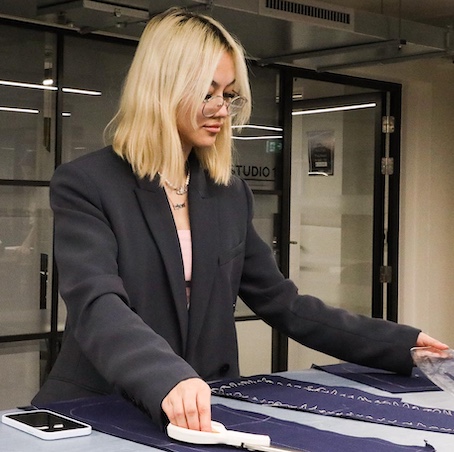
The advantage of a practical course is that you can start by learning the fundamentals. You don’t need to arrive knowing how to construct a jacket or draft a pattern. You can develop the skills step by step and then decide where you want to go next.
For students who discover they enjoy it, the FTA also offers Level 2 Stitching and Pattern Cutting as well as industry apprenticeships, providing a progression from introductory skills into more advanced garment construction and industry-standard techniques.
There are also specialist tailoring courses for those who want to explore more traditional and technical garment-making skills, including trouser making, waistcoat making, coat and jacket making, bespoke pattern making and a Level 3 Certificate in Tailoring.
So the journey doesn’t have to begin with a three-year commitment. It can begin with: “I’d like to see if I can do this.”
Practical skills can open unexpected doors
Learning to stitch or pattern cut isn’t only about becoming a fashion designer. Technical fashion skills can lead towards roles in garment production, pattern cutting, tailoring, garment technology, sampling and manufacturing, areas where practical expertise remains highly valuable to the UK fashion and textile industry.
You may also discover that the part of fashion you enjoy most isn’t the part you initially imagined.
You might arrive thinking you want to design clothes and discover that you love pattern cutting.
You might want to become a stylist and realise you are fascinated by garment construction.
Or you might discover an interest in tailoring, manufacturing or eventually starting your own label.
You don’t have to know the final destination before you take the first step.
What if you’re worried about making the “wrong” choice?
There is enormous pressure on young people to have a five-year plan. However, sometimes the only way to find out what you truly want to do is to have a go and experiment. A practical course can give you something that choosing a degree doesn’t always provide: the opportunity to try a skill and see whether you actually enjoy doing it.
That can be incredibly valuable.
Because the question isn’t simply:
“What career do I want?”
It can be:
“What am I good at?”
“What do I enjoy?”
“What skills are employers looking for?”
“What do I want to learn next?”
Those questions can lead you somewhere much more interesting than the plan you originally wrote down.
Results day is just the beginning
Whatever happens when you open your results, give yourself some space before deciding that your future has been determined by a few letters and numbers.
If you get the grades you wanted, celebrate.
If you miss your university offer, investigate your options.
If you’ve changed your mind, take that seriously too.
And if you’re interested in fashion, don’t assume the only way into the industry is a traditional university degree.
Practical skills, industry experience and the confidence to make things can be just as important in building a career.
Explore the FTA’s September courses
See the Fashion Technology Academy’s September 2026 courses
If you’re considering university, UCAS has up-to-date information on results day, Clearing and alternative options.
Top image: SHVETS production via pexels.com, fashion production images FTA


