


Keratin Bond Extensions: The Fashion Industry Styling Tool Behind the Look
29-09-2026


Hair extensions have long been part of the fashion stylist’s toolkit, but as runway, editorial and campaign looks become increasingly creative, keratin bond extensions are offering hair teams another way to transform a model’s look.
From creating dramatic length and volume for a fashion show to changing a model’s silhouette for an editorial, individual keratin bonds can be used to build a look that feels completely different from the model’s natural hair, while still moving and styling naturally.
Creating the look
Keratin bond extensions, also known as K-tip extensions, consist of individual strands pre-tipped with a small keratin capsule. A heated fusion tool softens the keratin, allowing the stylist to attach each strand to a small section of natural hair.
Unlike weft extensions, there is no continuous track. Each strand is attached individually, allowing the hair to move naturally and giving stylists considerably more freedom when creating a look. That flexibility can be particularly useful in fashion photography and catwalk work, where hair may need to be worn loose, swept back, braided, pulled into a ponytail or repeatedly restyled during a shoot.
For an editorial, extensions can change the proportions of a look completely, adding extra length, creating a fuller silhouette, introducing a different texture or providing enough hair to build a more sculptural style.
Extensions as part of the creative direction
For fashion teams, the question is not necessarily whether a model “needs” extensions. It is what the hair needs to communicate. Extra-long hair can create drama and movement in an image. Additional volume can give a sculptural updo greater impact. Extensions can also be used to introduce colour, texture or contrasting lengths without permanently changing the model’s own hair.
For catwalk shows, the practical advantage is consistency. A designer may want every model to have a particular length, density or silhouette, allowing the hair team to create a unified look across the casting. Because keratin bonds are relatively discreet when correctly applied, they can also give stylists freedom to change the direction of the hair without obvious tracks or attachment points becoming visible.
Why the individual strand matters
The construction of keratin bond extensions is particularly relevant when the finished look needs to withstand close-up photography / fashion presentations. With individual strands rather than a weft, weight is distributed across multiple small attachment points. Each strand can move independently, helping the extensions blend with the natural hair.
That can be important for beauty editorials and campaigns where the hair will be photographed or filmed in detail. Texture, movement and the transition between natural and extension hair all need to withstand high-resolution imagery.
Hair quality is critical
The quality of the extension hair becomes particularly important in professional fashion work. When hair is being photographed or filmed under studio lighting, repeatedly styled or manipulated by a hair team, inconsistencies in texture, tangling or shedding can become much more apparent.
Good-quality hair should be selected according to the model, the intended finish and the demands of the shoot or show. Colour, texture, length and weight all need to be considered before installation. For fashion productions, the hair team should also factor in how much heat styling, backcombing, product and restyling the extensions will need to withstand.
From catwalk to editorial
Keratin bonds can be used for very different creative purposes:
- Catwalk: creating a consistent length, volume or silhouette across a cast.
- Editorial: transforming a model’s proportions or creating exaggerated lengths and textures.
- Campaign and advertising: developing a recognisable hair identity that complements the brand’s creative direction.
- Beauty and hair shoots: providing density and movement for close-up photography.
- Lookbooks: creating polished, repeatable hairstyles across multiple looks.
- Creative projects: introducing dramatic colour, length or volume without permanently altering the model’s natural hair.
The key is that extensions become part of the overall image-making process, rather than simply an add-on to the hair.
The practical considerations
Keratin bonds typically remain in place for around four to six months in normal wear, although professional fashion work may involve a very different timescale. For a shoot or show, extensions may be installed specifically for the project and subsequently removed or maintained depending on the model’s schedule.
Application and removal should always be carried out correctly. Bonds should never be pulled from the natural hair, and experienced professionals should assess the model’s hair condition, density and the amount of additional weight being introduced.
Hair teams should also consider the production schedule. If a model is going straight from a runway show into another shoot, for example, the extensions need to be able to withstand repeated styling and changes in direction.
For a time-saving option stylists may opt for a weft-based alternative such as Genius Weft extensions offer a comparable semi-permanent result with a faster installation time. The Genius Weft track lays flat and can be cut to any width, making it a flexible option for hair professionals who wants to skip the strand-by-strand application process.
An Image Making Tool
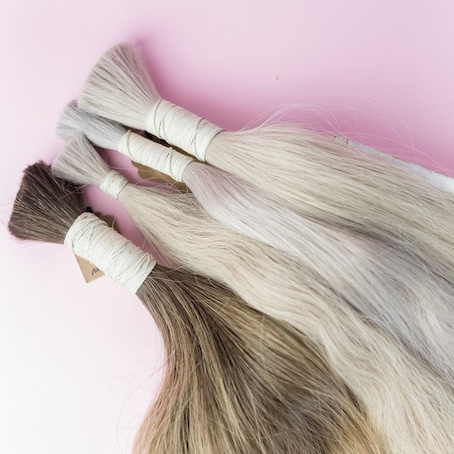
For the fashion industry, extensions are ultimately another material for creating a visual language. Just as designers manipulate fabric to change the silhouette of the body, hair teams can use length, volume, texture and movement to change the silhouette around the face and head. Quality hair extensions simply offer a particularly flexible way of doing that and for stylists looking to create their own weft hair extensions, wigs or I-tip custom braids bulk hair from the same Eastern European source is readily available. Buying bulk gives stylists complete control over tip size, weight and placement for a fully customised install.
Frequently Asked Questions
Do keratin bond extensions damage natural hair?
When applied and removed correctly, they don’t damage natural hair. The damage reputation comes from improper removal – specifically pulling bonds off without using a bond remover solution, or bonding too close to the scalp. A skilled stylist using the right tools and technique leaves natural hair intact.
Can you colour keratin bond extensions?
You can tone them or do minor colour adjustments, but heavy bleaching on pre-tipped extensions is not recommended. It’s better to order the extensions in a colour close to your target and do a mild toning treatment if needed.
How many strands do you need for a full head of keratin bonds?
Most individuals with medium density hair need between 100 and 150 strands for a full set that adds both length and volume. For those that just want added length with minimal volume change can sometimes work with 50 to 75 strands.
What is the difference between keratin bond extensions and clip-in extensions?
Keratin bonds are semi-permanent and applied by a stylist. They last four to six months and move like natural hair. Clip-in extensions are temporary, applied and removed at home, and need no professional installation. Clip-ins are ideal if you want flexibility; keratin bonds are ideal if you want to create a more natural look.
What is the difference between K-tip and keratin bond extensions?
K-tip and keratin bond are the same thing – both refer to extensions with a keratin capsule at the tip that fuses to natural hair using heat. The terms are used interchangeably in the industry.
Top image by Alina Skazka via pexels.com


