


The Hands Behind the Sparkle: Why Luxury Jewellery Still Depends on Stone Setters
25-09-2026


In fashion we talk a lot about designers. We celebrate the creative directors, the muses and the campaign faces. But when a diamond necklace catches the light on a red carpet, one person rarely gets a mention: the one who set the stones.
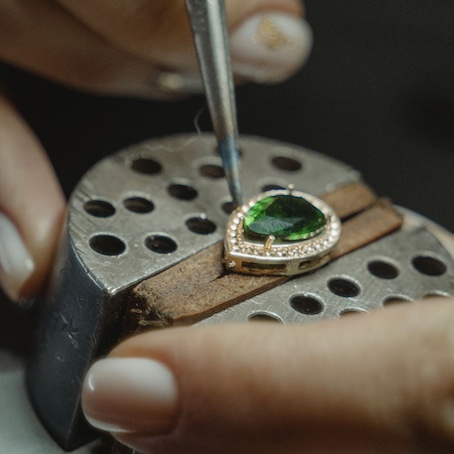
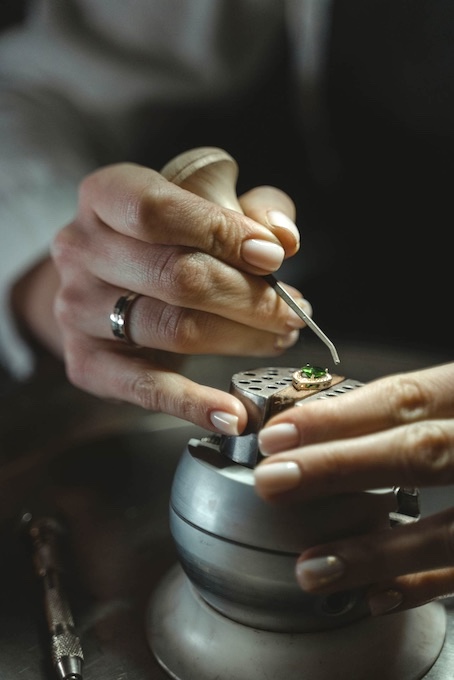
Stone setting is one of the oldest skills in jewellery making, and it’s still one of the hardest to master. The setter secures a gem into metal so it sits perfectly, stays put for decades and shows off all its fire. If the work is slightly off, the stone looks dull, sits crooked or falls out. At the high end of the market, there’s basically no room for error.
People talk a lot about 3D printing, CAD and automation, but no machine has replaced a skilled setter’s hands. Every stone behaves differently, and every mounting sets its own little puzzle. The judgement needed to solve it comes from years at the bench, not from software.
A craft that used to be kept secret
For centuries, setting techniques were closely guarded. Goldsmiths’ guilds passed knowledge down through strict apprenticeships, and workshops weren’t keen to share their tricks with outsiders.
That’s what makes the Gerardi family’s story so interesting. In the 1970s, the painter Salvatore Gerardi wanted to learn how jewellery was really made and found doors closed everywhere he went. So he paid master craftsmen just to let him watch. By 1983 he’d opened his own academy in Rome, the Accademia delle Arti Orafe, to teach openly what he’d struggled to learn.
Today his sons, Pier Paolo and Alessandro, run the Gerardi Setting School, a centre devoted entirely to stone setting. It’s growing fast. In 2025 it trained more than 200 stone setters across over 40,000 hours of specialist teaching. The academy says that’s more than any other institution worldwide reported that year.
Old skills, new tools
The school doesn’t treat tradition and technology as rivals. Every student works at a microscope linked to a screen, so masters can spot tiny details in real time and correct a mistake before it becomes permanent. Courses cover graver and microscope setting, Gravermax, engraving, wax modelling and CAD-CAM, so students leave with both the old craft and the modern toolkit.
The school is also truly international. Around 70% of its students travel from abroad, including from the US, Australia and the UK. Many graduates go straight into work, some with houses like Cartier, Bulgari, Damiani and Van Cleef & Arpels.
Why fashion should care
Luxury is increasingly about craftsmanship and provenance, and shoppers want to know who made their pieces and how. Stone setters are a huge part of that story, even if their names never appear on the box.
Director Pier Paolo Gerardi describes the mission as training “the best high-jewellery and stone-setting professionals in the world, merging innovation and Italian artisanal tradition.”
So next time a piece of jewellery stops you in your tracks, spare a thought for the hands that set it. They almost certainly spent years learning how.
Images by Tima Miroshnichenko via pexels.com


