


Promoting Work – Life Balance and Mental Wellbeing: Why It Matters and FEL’s Philosophy
05-12-2025


In an era where many businesses celebrate hustle, drive and dedication, there is an equally important conversation emerging: work-life balance and employee mental wellbeing. Being enthusiastic and hardworking are core traits employers often seek but without balance, these traits can lead to stress, burnout and diminished productivity.
Recent data from HSE.gov.uk shows how seriously this issue should be taken. According to the latest annual statistics from Health and Safety Executive (HSE) for 2024/25, an estimated 964,000 UK workers suffered from work-related stress, depression, or anxiety. These conditions drove a staggering 22.1 million working days lost part of a total of 40.1 million working days lost due to work-related illness and workplace injury.
Even more telling: a 2025 survey by Corndel found that half of UK employees regularly experience workplace anxiety, with younger workers especially affected: 64% of those aged 18–34 reported anxiety at least once a week.
Clearly, poor work–life balance and unchecked stress are no longer fringe concerns – they are central to workforce health, retention, and business resilience.
A recent example that caught global attention was highlighted by Simon Cowell during an interview on Steve Bartlett’s Diary of a CEO. Known for decades as a self-confessed workaholic, Cowell revealed that he has now instituted Fridays off and never responds to emails after 5pm – a dramatic and intentional carve-out for personal and family time.
This shift mirrors a broader movement across UK workplaces. As we head toward 2026, businesses are realising that burnout is bad business. Enthusiasm and hard work remain valuable, but without balance, they quickly lead to stress, disengagement, and declining performance.
The Business Case for Supporting Balance & Mental Health
Supporting employee wellbeing isn’t just ethical – it’s smart business. According to a 2025 report from the Mental Health Foundation, a 32-hour working week (with no pay cut) led to significant wellbeing gains: around 69% of staff reported reduced work-related stress, and almost 80% reported improved work–life balance.
Moreover, a recent UK-wide CIPD survey on health and wellbeing at work found that a worrying portion of employees, roughly a quarter, believe their work has a negative impact on their mental and physical health.
Other research from Cornell University. published in 2025, supports what many HR professionals know already: flexible working, respect for personal time, and genuine employee-centred policies all strongly correlate with higher motivation, lower burnout, greater job satisfaction and longer-term staff retention.
When employees are supported to balance work and personal life rather than being pushed for constant output organisations benefit from improved morale, loyalty, and sustainable performance.

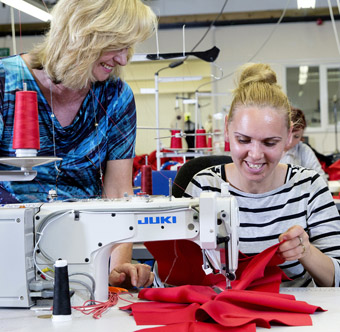
(The FEL team in Haringey, London)
FEL’s Approach: The TRIBE Stance
At Fashion-Enter Ltd, CEO Jenny Holloway recognised early on that strong values and genuine care for people must underpin any sustainable business. To reflect this, FEL has established the TRIBE stance, a guiding philosophy for how the company treats its team:
- T — Tradition: We operate on core values, and treat our staff as part of a family, not just as resources.
- R — Relevance: We ensure everyone understands the purpose behind what we do — why their work matters.
- I — Individual: We recognise each person is unique, with individual needs, strengths, and challenges.
- B — Belonging: We foster a sense of community, inclusivity, and mutual support among all employees.
- E — Ethics: We encourage every team member to “be true to yourself” — to act with integrity, honesty, and respect for personal wellbeing.
This philosophy informs FEL’s policies and everyday practices. For example:
- Flexible working hours and respect for personal time to help staff manage personal commitments, avoid burnout, and sustain a healthy work–life equilibrium.
- Open communication and mental health awareness: encouraging staff to speak up if they feel under pressure and offering support rather than stigma.
- Recognition of individual needs: understanding that not every employee thrives under the same structure and adapting accordingly.
- Building a sense of belonging, so that staff feel valued as individuals, not just cogs in a production line.
- Upholding ethical treatment, which includes understanding that long-term productivity depends on mental and physical wellbeing, not overwork.
By living the TRIBE values, FEL aims to create not just a workforce but a community. That, in turn, builds loyalty, low turnover and a strong employer brand.
Why FEL’s Philosophy Matters — Especially as we head into 2026
Against the backdrop of rising work-related mental health issues across the UK, FEL’s TRIBE stance is not just well intentioned – it’s forward-thinking and necessary. The prevalence of stress, depression, and anxiety among working Brits has reached record levels.
Moreover, with younger staff members disproportionately affected, companies that ignore these issues risk high turnover, disengagement, and declining performance, especially as younger generations increasingly prioritise mental health and work–life balance over long hours.
FEL’s commitment to TRIBE means the company is actively investing in its people, not just output creating a stable, supportive workplace and safeguarding its long-term success.
Work-life balance and mental health are no longer “nice-to-haves” they are essential to sustainable business success in 2025 and beyond. As UK data shows, workplace stress, anxiety, and depression remain widespread and costly, both to workers and employers.
By adopting the TRIBE stance, Fashion-Enter Ltd is demonstrating how a values-driven, people-first approach can lead to a happier, healthier workplace. In doing so, FEL isn’t just producing great services and products – it’s building a workplace that respects people as individuals first, employees second.


